
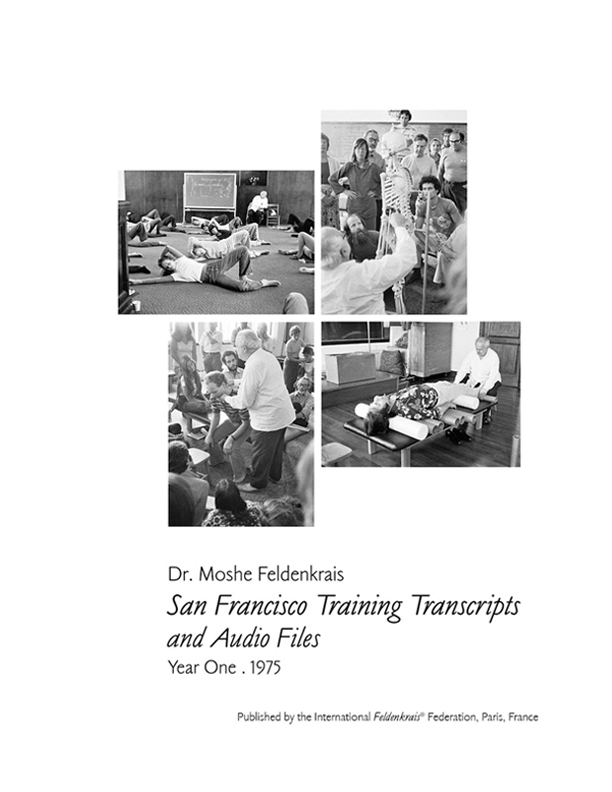
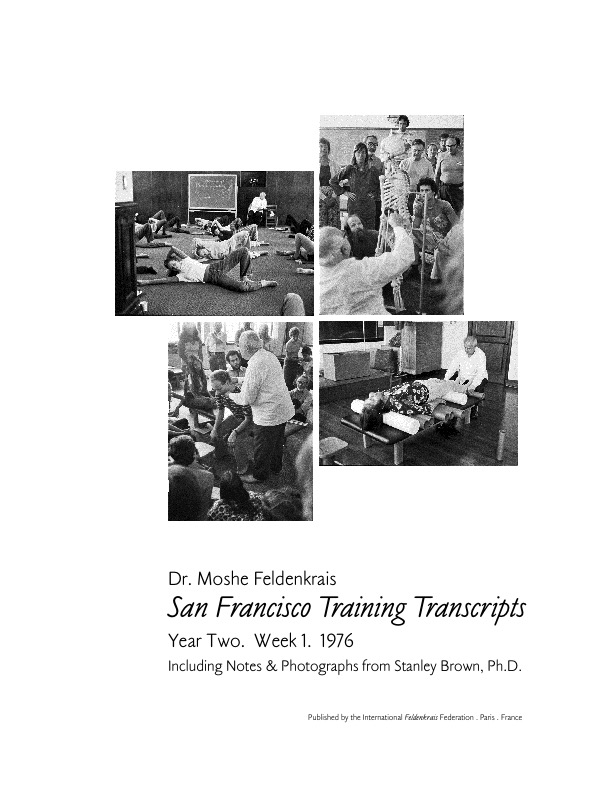
Table of Contents
To view, please choose an item below, then click the + symbol.
1975
Week 1 - revised edition: 16-20 June 1975
Day 1, Week 1: Monday June 16, 1975
Morning
1 – Introduction
We don’t remove blocks, we don’t teach people, we don’t treat them
1 – When a person does something, it’s a major thing, the whole nervous system participates
2 – Our language is made in such a way that it doesn’t fit at all our work and our teaching
4 – When somebody comes to me with a multiple sclerosis
6 – You will find that we want to know, and if we don’t know, we can’t feel, and if we don’t
feel, we can’t know
7 – All must improve approximately the same amount during each lesson
7 – Awareness Through Movement: Arm to the Ceiling
7 – You can see who is influenced by the person and who is influenced by the space
8 – Any act must have all those three ingredients
8 – Working with a large group is more important than working with your hands
11 – That imitative way is the most primitive way of teaching
13 – Perhaps the most important thing that you will carry away from this course: we act in a peculiar, personal way
13 – Sir Arthur Keith shows that there are 49 vestigial muscles
14 – Every one of us has an image of the body that is due to genetic inheritance and personal experience
15 – None of us had real optimal conditions for development
17 – What happens to those cells we don’t use?
18 – The parts that are used improve with age like good wine
Afternoon
21 – Logistics
21 – You should leave an hour between the meal and starting work here
21 – Story of Gurdjieff going to see a very famous guru in the mountains
23 – Westinghouse has a contract with me where they publishing my lectures
24 – Awareness Through Movement: Arm to the Ceiling, continued
25 – The cubitus and radius can turn like that and like that, and that’s not a simple thing
28 – Who is “you”? Is your leg you? Is your penis you?
29 – Movement done by a living nervous system behaves exactly like a skeleton without a
nervous system
29 – You can see what the head thinks through the movement
30 – Every act that is aware, that is conscious has this quality, which is reproducibility
33 – Hurry is confusion, and fast is fast
35 – The human nervous system is different from all other nervous systems.
36 – Questions and Answers
36 – There is not a silly question—there is only a silly answer
36 – Student question: Could anyone reach up…regardless of their unique skeletal structure?
37 – Story of Mia Segal not liking a person
38 – Awareness Through Movement: Arm to the Ceiling, continued
38 – We are all like that. We are unable to attend to ourselves completely
40 – We can’t think any faster than we can move
42 – Anything a baby wants to do is wrong
45 – When a thing is done like the human nervous system does it at its best, the movement resembles from one body to another
51 – A muscle is not intelligent. A muscle is like a spring—it pulls both sides
55 – Freedom of action, that’s the most important prerogative of the human race
55 – There are parts which nobody actually takes away from us but ourselves. That part I want
to give you back
Day 2, Week 1: Tuesday June 17, 1975
Morning
57 – Pre-Class Conversations
58 – Awareness Through Movement: Lifting the Head on the Back (Flexors)
58 – Why is it so difficult to lift the head?
62 – What you achieve in learning is not only the thing that you have learned
63 – It’s no use correcting that, because if you correct it now, next minute you will do the
same thing
64 – Have you ever been to a mortuary where dead bodies lie?
64 – When you lie on the floor, the object is not to have the gravitational organization of the
body involved
64 – If you were intelligent people, your lower jaw should open
68 – Look what happens—their reference is not to their body but to the room
69 – That little world is the world of omnipotence and it is the private world of that child
70 – In that big world, we are less important than the smallest grain of sand
73 – There is nothing that is correct, only what is good for you
74 – Every great culture had slaves
75 – We need some experience before we can think
76 – Conversations During the Break
78 – Awareness Through Movement: Lifting the Head on the Back (Flexors), continued
80 – Our back, spine, ribs, organize themselves to have one way of interlacing the fingers
81 – A human being who is not using his ability to be aware is working below par
84 – We strain when we do anything which should be done gracefully
84 – We are wired in since our childhood that anything that’s easy means you haven’t made
the necessary effort
Afternoon
89 – Pre-Class Conversation
92 – Talk
92 – All the muscles divide themselves in two kinds: flexors and extensors
93 – There is a question of structure and function, always
93 – don’t see but what your brain can see
93 – Svante Arrhenius’, a Swedish chemist, had a definition of structure and function
94 – What we are doing is just trying to throw behaviorism overboard
95 – There is a kind of notion called chronaxie
95 – An extensor can do extraordinary things
96 – What is the idea of working on flexors only?
99 – Muscles that are contracted are, first of all, weak
102 – You will not know it unless it is woven into your life
105 – Only those who waste time are potent people; the impotent people have no time
106 – Awareness Through Movement: Lifting the Head on the Belly (Extensors) and some Lifting the Head on the Back (Flexors)
109 – Differentiation, that’s how we learn
109 – It’s inherent in the human brain that it should be able to construct an environment around it which makes it comfortable to live
113 – Once you become aware of the thing several times… You are master
114 – Some believe they will get better by repeating the same thing a million times
115 – If you measured the I.Q. yesterday and today, you would find 30 units difference
117 – Our mind is so made that, the more you get a new thing, you forget the old one
Day 3, Week 1: Wednesday June 18, 1975
Morning
119 – Announcements
121 – One of the highlights of coming here was that Pribram agreed to come
125 – I would like to speak on a Telstar and I will do it for nothing
128 – Talk
128 – There is a sequence of different parts of the brain coming into function one after the other
129 – The actual activity is one of the most important things in human physiology
130 – All living things are capable of doing something against gravity
130 – In the human makeup, the ontogenetical does something which in other animals is done phylogenetically
131 – Story of when the Australian Acacia was transported to Israel
132 – Most animals, in most respects, are superior to human beings
134 – Most of the things we want to know we don’t know
135 – I try first to give an outline so that you can see the whole frame
136 – Awareness Through Movement: Scanning and Measuring to Clarify the Self-Image
137 – A human structure can be represented by a circle with five lines
138 – Is there anybody who knows where his hip joint is?
140 – This is one of the reasons why Europeans can’t sit in the lotus position
142 – There is no joint where there is no movement
145 – Very few people eat normally, and therefore, very few people are really healthy
146 – The internal sensation of the size of the body, that’s our body image. We act with that
147 – What is objectivity? What is subjectivity?
148 – Story of Jew who measured his wife’s foot to buy her a pair of shoes
149 – We have no instrument in the body that measures the real amount of work we have done
151 – Only those parts that you use, it’s around them that you have built all your life
Afternoon
153 – Pre-Class Conversations
154 – Awareness Through Movement: In Sitting, Twisting with the Eyes
154 – Leaning on the hand, it’s to take away the weight and the necessity of keeping balance
154 – Can you think yes and no at the same time?
155 – Can you say that you can breathe correctly which would be good for all occasions?
156 – There is no organ in our body that is not used for two purposes, at least
157 – What is said about in the books, even in physiology, is mostly wrong
161 – Why can’t you move the eyes faster?
169 – Talk
169 – See how a little movement with the eyes actually make such a different angle of rotation
171 – Until the last two Olympic games, nobody thought that it was possible to jump more than
2 meters and 6 centimeters
173 – From babyhood to adult stage, we have to differentiate to be able to organize
174 – The stiffness of the back and the stiffness of the muscles is not an objective reality
175 – There are righting reflexes which make us regain balance when we slip
176 – As soon as I turn the eyes—how much? Until I see him with both eyes equally
178 – For the directional things there are two organs, and they all are in the head, and they all
move around the vertical axis
179 – Awareness Through Movement: In Sitting, Twisting with the Eyes, continued
180 – If the pattern is fixed and you maintain it, it won’t dissolve itself
181 – You have to work in order to be able to know how to think
182 – You can, in one hour, stabilize scoliosis; You can straighten it within one hour
183 – Why can’t you preserve the knowledge of a movement? And in fact you can
184 – Story of a blind man that became the president of the United Nations Food Office
185 – When you learn to look and observe and understand, you don’t have to write it
Day 4, Week 1: Thursday June 19, 1975
Morning
187 – Talk
187 – The fact that he fell asleep during a lesson shows only that he has a healthy brain
187 – Story of Marie Curie being a great hypnotist
188 – Awareness Through Movement: Rolling the Pelvis with Soles of the Feet Touching
190 – Your disease is your body image, which is fixed and doesn’t want to change
191 – The head is the primal mover
193 – You have no say in them and yet they are voluntary muscles
196 – When the knees are open, the chin is down near to your throat. Why is that so?
198 – I have found myself discovering something I thought nobody has ever thought, and then
was surprised I had read it many years ago
200 – Talk
200 – One finger being more differentiated or less divides the humanity into two classes: those
who can make music and those only who pay for tickets to listen music
203 – The thumb is essential for any movement
204 – When we did yesterday the movement of the eyes…some people felt sad
205 – the difficulty of moving the eyes is replaced…all the emotion ever linked with it, which was suppressed, comes clearly to your mind
206 – Drugs and emotional difficulties—how do you do put the things together?
207 – The moment a person has made a change, he begins to tell you when it first happened
208 – Story of the first man Dr. Feldenkrais ever worked with, Mr. Boston
213 – Story about the drug Largactil, L-dopa, mental illness and Parkinsonian diseases
215 – There is no definition in medicine what is health
215 – Story of Dr. Feldenkrais’ brother’s kidney stones
218 – Stories about Noguchi
220 – Story of Yehudi Menuhin, the violinist, taking what he learned and using it all his life
Afternoon
223 – Pre-Class Conversations
224 – Awareness Through Movement: Rolling the Pelvis with Soles of the Feet Touching,
continued
226 – You have to do fast and slow. You have to do both
228 – Story of the wife of a rabbi who agreed the lesson improved family life
229 – That’s what exercise does to you. It makes you sure that your faults will be ingrained and
as stabilized as what you want
231 – This way of teaching, it’s not enforcing my opinion, nor my will, nor my preference on
anybody. It’s only giving you the freedom of choice
233 – Story about a Japanese man who trained mentally and became a Judo champion
234 – Story about a study done on heart patients in which one group just thought about jogging
236 – There is no function in life that does not help pass time—it means go nearer to the grave
236 – Story of Dr. Feldenkrais’ mother who didn’t put on weight
237 – Story of a chap who stopped feeding his horse
239 – Everything around you is made to use with the right hand
245 – Psychiatrists from the Viennese school have influenced the American way of thinking
246 – From now on I will not say the word “try,” to show you that it is possible
Day 5, Week 11: Friday June 20, 1975
Morning
255 – First Discussion Between Dr. Karl Pribram and Dr. Moshe Feldenkrais
257 – Encoded in my brain is something that allows me to write with my left hand, my toes,
my teeth
258 – The difference between awareness and consciousness, where is it in the brain?
259 – Stories about brain lesions that make monkeys and humans do things they’re unaware of
262 – What is the real thing consciousness does, that without it we would not be the Homo
sapiens that we are?
264 – What is really going on in the attention when the attention is directed in a particular way?
264 – Despite all this input that we can be sensitive to, and the limits on capacity, the limit isn’t
on the motor side
267 – We’ve got two brains in our heads, aside from the fact that we have two hemispheres
270 – There may be a million neurons. Are they a brain? Certainly not
280 – The cerebellum has three parts
281 – Neurophysiologically, how do you view the changing of our fixed patterns of seeing the world?
282 – Think of the brain as a stability system, like a thermostatic system
283 – In all the parts we have talked until now we didn’t mention the word frontal lobe
284 – There must be a time where there is a wiping out , cleaning it so that it’s
ready to change a function
287 – There’s an evolution, and if you skip one, you can work for months years without results
Every part of the brain has the three parts
Week 2 - revised edition: 23-26 June 1975
Day 1, Week 2: Monday June 23, 1975
Morning
1 – Talk
1 – I feel well now, I am organized, but how can I keep it?
2 – How come that we know that 5 times 6 is 30 without doing it?
3 – I believe not only it’s a question of 100 percent, but you can get 200, 500, 10,000 percent
4 – All the things that depend on learning…they are always of social importance
5 – Story of Professor Schmidt of the League of Nations who knew 80 languages
7 – You can’t think faster than speaking
8 – The importance of bisexuality in nature, in evolution—who wants bisexuality?
10 – The things that you have in common with me, they are unimportant. But the thing that you
have different from me and different from her is unique
12 – Conversations During the Break
16 – Awareness Through Movement: On the Stomach, Tilting Legs to the Left
17 – It’s like driving a car with the brakes on, and then telling you that car needs correction
20 – It’s called translation in mechanics—translate the head right and left
21 – Pecking the chin is the way all the birds keep balance
22 – There are no two people who walk the same way
23 – Everything we have a say is gradual. It’s possible to find 50 nuances
24 – As nobody knows where the pelvic joints are, the muscles there work in an idiotic way
26 – Story from the Talmud: a Greek asks a child how to go from here to there in Jerusalem
26 – You must use your ability to focus attention…on the whole picture and on details
26- -You give a mantra, something completely useless, to get busy so that there is no intent
27 – Once we do a movement in a certain way many times, we have the greatest difficulty in
the world to get rid of
31 = “We want freedom.” It means to destroy what you have but have nothing to place instead
Afternoon
35 – Pre-Class Conversations
36 – Talk and Demonstration from Awareness Through Movement: On the Stomach, Tilting
the Legs
36 – There is one thing of being able to do it and another thing to really get the important part
of the interference
37 – The shoulder blade can move many inches. With most people, it doesn’t move at all
38 – Frisch, he showed that bees have dances
38 – We can do things we don’t know how we do it. How do you laugh?
40 – Awareness Through Movement: On the Stomach, Tilting the Legs, continued
41 – Make your life around that so that you don’t have to work, though you will be busy 24
hours a day
43 – You can’t learn from anybody else better than from yourself
44 – Their body would not allow to make such a tremendous reorganization in one go
47 – The things we do are actually the laws of functioning of our nervous system
48 – But there is a limit as far as efficiency of learning goes
49 – Awareness Through Movement: Supine, Tilting Crossed Legs and Rolling the Chest
53 – Find what makes him tick. Why does he do it like that?
54 – The shorter the pendulum, the faster it is
56 – To me, using a movement is only to make the brain tick better, that’s all
58 – I am in principle against imitation. But there are cases where it is so much easier to do
like everybody else and imitate
Day 2, Week 2: Tuesday June 24, 1975
Morning
61 – Announcement
63 – Talk
63 – Why do we want tables?
63 – The pressure on the feet distributes the tonus around all the muscles of the body
64 – In the standing position, it’s very long before it dawns on the person what you want
64 – M. F. Alexander did the impossible
65 – Our breathing depends on gravity, believe it or not
67 – Guthrie showed you cannot be awake without having cues of consciousness
68 – Freud, what did he do?
69 – Intuition is not something you get out from God
71 – Freud went to Charcot, learned hypnosis
72 – Only in the last year or two, I began to touch the pubic bone
72 – Story of a young woman in Eilat who had pain at the end of the coccyx
76 – You work on the body, and then you think nothing of the ears
78 – You know there is a Ménière’s syndrome?
82 – Awareness Through Movement: Lifting the Foot, Holding with Both Hands
87 – For primitive movement we are equal
89 – Gurdjieff would use a “Stop!”, which is actually examination of reversibility
90 – A quack must know every detail. He cannot afford to kill anybody or to make a real great mistake
Afternoon
93 – Talk
93 – The object is to improve the rate of learning and the amount of retention
94 – The way I offer you to know thyself is different from anything you have done before
95 – The number of cells in the entire nervous system was always thought to be around about
10 to the power 10
96 – Compared with the internal life, the external life is insignificant
96 – Story of learning katsu with Koizumi
99 – It is essential to remove any intent to help, to cure, to do anything with the person
100 – The Fechner-Weber law shows that all our sensations are connected to the stimulus that produces them in a logarithmic way
101 – Story from the film Dr. Knock of the peasant who comes to see him
103 – If you want to become sensitive to imponderables, to things that nobody else can feel,
reduce the power of touching
107 – All our senses—sight, hearing, smell—are built in the same way
110 – Awareness Through Movement: Lifting the Foot, Holding with Both Hands, continued
110 – The ape-like use of the hand is important because
112 – No habitual patterns are written down by God
113 – It’s pleasurable that you have the authority over your body in space and internally
114 – As soon as you don’t find a correct way of doing it quickly, you haven’t got the patience
114 – If you begin to think and you talk, you are not thinking
116 – You will see that there are parts of space which are part of our body
119 – When the back is softer, you don’t have to stretch anything.
119 – You should be lazy. If you are lazy, you will be intelligent
120 – Most people would go on pulling and pulling and never would think of rolling
Day 3, Week 2: Wednesday June 25, 1975
Morning
123 – Pre-Class Conversations
127 – Talk
129 – You can’t have a function without a structure
131 – Imagine a nervous system which grew in the optimal conditions
132 – How can I tell a hunchback that he is not ?
134 – Our body, our skeleton, is made differently from all the others
135 – Story of Madame Chaumière’s uranium poisoning
137 – The skeleton makes us weightless
137 – When there is no movement, there is no force
141 – There is only one way in which I can teach what I teach: by successive approximations
145 – There are six directions in which the body can move
146 – The definition of a good posture is not the form or the shape of the body, but the function
147 – You know what a Foucault pendulum is?
149 – Le Chatelier’s principle of equilibrium
151 – It’s very difficult to balance an inverted pendulum
153 – The structure of our walking is made…to preserve the center of gravity at its highest point
154 – There are some movements which we do faster than any other animal
Afternoon
157 – Pre-Class Conversations
159 – I start on the dot. I actually will look at the watch and start not a minute later
160 – Awareness Through Movement: From Lying on the Back to Sitting
160 – People think that they have made strong stomach muscles
161 – If you fall, it shows that the intent is greater than your ability to learn
162 – In war and in love, everything is permitted
164 – A body can’t change so quickly. A brain can’t change so quickly
164 – Every second person comes with pain
167 – You must set about it in a very easy way to learn a very difficult thing
169 – So long as you’re not dead you can recover and do better than anybody else
171 – You find that joy of having got rid of a nuisance that you carried since early childhood
173 – The knowledge that you can’t do it makes the intent even greater
185 – is not important that everybody is perfect
Day 4, Week 2: Thursday June 26, 1975
Morning
187 – Pre-Class Conversations
188 – Awareness Through Movement: Standing, Tilting to the Side
191 – Everybody does symmetrically and any inequality between right and left remains for life
192 – To go home is a general function of all living things
193 – The suppleness of the spine is not a question of muscles and bones, but a question of
slowness of thinking
196 – A baby starts knowing himself only by touching himself
203 – Everyone says, “My right side is very poor.” Nobody says, “I am poor on the right side.”
204 – There is no specific treatment except the brain—learning
206 – If you try to change some of the habitual trouble with medical treatment, it’s usually a
disaster
207 – If you keep on exercising that fault whenever you try to learn something, you actually
rehearse and condition it
209 – The breathing apparatus is hanged on the cervical vertebrae and the head itself
209 – If a muscle is engaged in doing something, you cannot force it do another thing
210 – The things we do habitually…they must be fast if you want to use them in your life
211 – We think of control as forcing, as obliging something…but there is organic control
214 – Story of people in concentration camps whose bodies gave everything to keep their brains intact
Afternoon
217 – Talk
218 – I don’t prepare my lessons
219 – I would like
220 – You have to be able to see the wood and the tree, the trees and the wood, and shift the attention from one to the other
221 – The right thing is to do is not only recall but recall again at home
222 – Awareness Through Movement: Standing, Tilting to the Side, continued
223 – The fastness of the movement is really only in the central part
226 – That’s why actors have nights where they are perfect, and other nights they are a washout
228 – That’s why when we turn the head to the right to touch the arm, it turns with the palm up
230 – That’s why people who skate and want to turn start with extended arms and legs
233 – In one part of the spine there is no movement and never bends to the other side, therefore it’s a scoliosis of the spine
234 – Feeling equal is not enough. You have to…be able to check your feeling
235 – Any joint without movement deteriorates, degenerates
236 – Before you felt pain in the tooth, was forming already at least three years
238 – If you have no awareness, you cannot preserve your spine from deterioration
Week 3 - revised edition: 30 June - 2 July 1975
Day 1, Week 3: Monday Morning June 30, 1975
1 – Awareness Through Movement: Lengthening the Arms, Standing and Sitting
5 – Normally where do you say “right and left”? Relative to your face, to your head?
7 – Where is downwards? Is it in between the feet?
8 – Story of a Japanese woman who stuck a pencil in her navel
8 – Where is the center of gravity of the body?
10 – You can get an ideal standing which fits the mathematical definition of center of gravity
11 – As the Japanese sit on the floor…the movement of their legs is extraordinary
12 – In jumping and in running, it’s of course the velocity that counts, not the power
13 – You can use our brain to outdo the natural differences that we have
18 – We want to make that at home, then the whole world is yours at home
22 – It’s a very important thing to be able to decide, “Ah, I should do this movement now”
24 – Don’t do anything…It’s one of the most important things you can learn
26 – Pavlov tried to find out whether animals can tell between left and right
Afternoon
29 – Talk
29 – Awareness Through Movement: Lengthening the Arm Behind the Head
29 – The heels together, the heels outward—what’s the correct thing?
31 – If the foot doesn’t lie properly, it’s we that don’t lie properly with the foot
39 – Story of Dr. Feldenkrais and Koizumi going to a masseur at the Piccadilly police station
45 – You can help yourself with anything because it facilitates learning
46 – Story about a student proving for himself how to detach thinking from verbalizing
50 – Ideally you should have one lesson a day, not four
Day 2, Week 3: Tuesday Morning July 1, 1975
55 – Awareness Through Movement: On the Stomach, Turning the Head
59 – Visualize all these movements, because in the manipulating work you will have to do
with the head of some other person
64 – Awareness Through Movement: Breathing
65 – At the early stages of the embryo, the heart beats before there is any nerve fiber touching
66 – Breathing and heartbeat are inseparable
67 – Hold your breath like that and count, and see whether the pulse accelerates or decelerates
69 – Any prescription for correct breathing is equivalent to a prescription of correct speaking
70 – Everything we know about breathing is not fully correct
74 – just breathes out, pushing the abdomen out
75 – How come that a lion watches a gazelle coming and makes a roar?
76 – Drawing in the abdomen for breathing out is done only when we don’t need much air
Afternoon
83 – Awareness Through Movement: Rolling Pelvis, Arms and Head
87 – Talk
88 – Before there is breathing, the embryo takes in the mother’s uterine waters and pushes
them out
89 – There is an enormous difference in size and amount of air into the right and left lungs
90 – The whole range of movement is from a quarter to a third of an inch
91 – When you make pressure in the stomach, you cannot make it only forward
91 – Some of the martial arts teach a very efficient use of the diaphragm and the abdomen
92 – Each function should not have a compulsive element
93 – Story of people in India playing the flute with cobra snakes
94 – Awareness Through Movement: Breathing, continued
94 – Put your hand on your lower abdomen and laugh. What happens?
95 – You can’t take out the rhinic system and keep an animal alive
96 – Close your mouth before , swallow your saliva, and let the body do
whatever it wants after
97 – If there were no physical laws for the air outside that make it come in, we could never
breathe in
97 – When we drink, when we eat, the lungs must be shut off
98 – We’ll also show you the ratio of length of the breathing in and the breathing out
99 – All the things I taught today, all of them were contrary to what I have learned, previously
to thinking for myself
100 – If you look at any animal who makes a loud noise, you will see that they all push their abdomen out and breathe out
100 – Story of how four of Dr. Feldenkrais’ ribs were broken
101 – Who, what regulates our breathing? It’s a place in the brain called the superior olive
102 – It’s impossible to empty the lung completely
106 – Story of Dr. Feldenkrais’ Judo teacher, Gunji Koizumi, an extraordinary man
Day 3, Week 3: Wednesday Morning July 2, 1975
111 – Talk
113 – You are there to be able to detect what hinders him
115 – Form in your mind an ideal skeleton so you can detect in the person where is it farthest
from that idea
116 – And for another reason we call it Functional Integration
117 – Freud found some of the fundamentals of the working of our brain and nervous system
118 – There is only one set of muscles to express whatever happens in the nervous system
120 – That is actually removing latent, parasitic contractions which we enact without knowing
121 – The hunchback should be put in a position like any normal person, like the ideal person
122 – You cannot maintain an attitude which is futile for more than a few minutes
124 – It becomes a problem of your sensitivity and of your appreciation what is the ideal
125 – The biggest error is unique…the smaller the errors are, the more of them there are
126 – Story of a lady who asked for her dollar back because Pribram insulted women during his talk
129 – If you become ideal in a midst of a society who is far away from that, then you are mad
131 – The teaching should be within the limit of what the person can do
134 – Awareness Through Movement: Walking on the Toes and Heels
136 – Story of how orderly people move in and out of subway trains in Japan
138 – A lesson like that, that’s a lesson of gymnastics
139 – To human beings, growth means continuous learning and ability to see the same thing otherwise
139 – In each lesson there must be distinction. That means you must create a contrast
Afternoon
141 – Thomas Hanna Suggests Books for Further Study
151 – Talk
152 – I brought my catalogue from my own private library just to give you titles of books
153 – Functional Integration Demonstration and Practice
154 – That looks mysterious and as if I have a special sensitivity. It’s cultured, cultivated. We
will cultivate it in every one of you
155 – Our nervous system, if you go the way it is structured to learn, it learns instantaneously
157 – You have to be nearer to the ideal body before you can teach another body to improve
157 – Different bodies will behave differently, and that is the first experience you try to get now
158 – Sensorially, if you go beyond words, you get a direct learning which you can’t beat
158 – People will laugh when you present them with a task which is above them
161 – Talk
161 – People think that when they learn they will become omnipotent—don’t kid yourself
162 – We will bring here people who can’t afford to pay a private treatment
163 – To make a person a straight back and morally destroyed is just as bad.
165 – Side Conversations During Functional Integration Practice
172 – Functional Integration Demonstration
173 – If you cannot distinguish, you cannot teach
174 – Don’t be afraid to ask silly questions. They are the only ones which are worth answering
Day 4, Week 3: Thursday Morning July 3, 1975
175 – Talk
175 – In all medical sciences, everything that was known was not studied on healthy people but always on the sick
176 – You don’t need to be ideal to be in a state of functioning properly
176 – Like every disease, the host and the parasite come to terms
176 – Story of what happened when Napoleon invade Lombardy
178 – There are deformations, troubles, that you should not strive to correct
180 – The body and brain are made for movement and not for static equilibrium
180 – Story of Professor René Leriche’s discovery about how to recover from knee injuries
186 – You’ve seen that we press and push. Now what for do we do it?
188 – In every country in the world, there are bone setters
189 – Any force which is not normal to the surface, is destructive as far as the human spine goes
192 – That is important, that skill of finding the point where your pressure is the most efficient
192 – Contrary to other techniques which only use pull, we use pressure
193 – Bob Knighton had a car accident and was laid up with a destruction that few survive
194 – Functional Integration Demonstration and Practice
195 – A very minute movement, if properly arranged in the direction, can move the whole body
197 – We must know what the skeleton is for
197 – Story of Enrico Rastelli, the Italian juggler
197 – Story of Grock, the Swiss clown
199 – Work in physics and mechanics is force multiplied by distance
200 – You will find that when you do it really well, the person is not so pleased
204 – Story of Dr. Feldenkrais being the guinea pig on which students practiced
Afternoon
207 – Functional Integration Demonstration and Practice
207 – The familiar things are very difficult to see
207 – You should be able to see…that it will be painful in the neck
209 – If you find the important thing, then it’s as clear as the Bible
211 – Is the middle of the head in the middle of the legs?
211 – There is the genetic inheritance she had to learn to stand, to use her eyes
212 – If it’s only the slight difference in the eye, then normally through the use they will correct themselves
213 – What do you mean by “nature”?
216 – You needn’t do anything. Just make her aware, it gets better
218 – What is the most prominent trouble? That is the most difficult problem I’m asking you
218 – Which side is the scoliosis?
223 – Talk
224 – Most people think that human beings and human thinking is not natural
226 – The Russian Academy of Medicine found that acupuncture was most efficient in the
emotional diseases
227 – We feel unsafe that there are things that we cannot find the cause and effect
228 – Erasmus shows that in fact, the world lives by stupidity, not by intelligence
229 – Story of two Jews at a vespasienne in France
Week 4 - revised edition: 7-10 July 1975
Day 1, Week 4: Monday July 7, 1975
Morning
1 – Pre-Class Conversations
2 – Awareness Through Movement: Differentiating Movements of the Foot
4 – This thing will happen mostly with dancers because they have so much tonus here
7 – Individuality and personality should express itself in the higher performances of the
human being
9 – My way is not teaching you what I want, but to make you aware of what you do
10 – In the motor cortex, the leg is a thin line
12 – You must be able to be interested in the thing you do and forget what it is for
14 – In the brain there was never made that pattern… therefore, what’s the point of doing it
with strength and fast? It won’t work
16 – Most people, except artists and some scientists, actually develop their ability
16 – Neurotic people have a better chance of improving
17 – We don’t want to prove that the foot is a bad foot
20 – My way of doing it is trying to make it methodically available to every one of us
Afternoon
27 – Functional Integration Demonstration and Practice
31 – I am only a normal human being and don’t ascribe myself any superior qualities
31 – A normal knee should have no lateral play
32 – In rotations, fast rotation, the heel must come first
34 – Functional Integration Lesson 1 with Phyllis
34 – Never believe a patient, what he says…but listen to him very carefully
36 – Story of a skier who had pieces of steel put in her knees
37 – Story of people in England not knowing what kind of operations they had
40 – Where is the scoliosis? It’s very difficult to decide
41 – When you push where the push should be, you will see always the head going taller
Day 2, Week 4: Tuesday July 8, 1975
Morning
47 – Discussion of Yesterday’s Functional Integration Lesson with Phyllis
47 – You have to learn…to keep your mouth shut
47 – The first thing I saw on that woman…was that she has a sprained lower jaw
48 – I listen very carefully…30 years later I remember what they said
49 – Story of Dr. Feldenkrais working with a girl of 18 who almost drown in the sea
51 – The axis and atlas are usually the last vertebrae to get involved in any trouble
53 – Don’t read the medical report before you have touched and examined the person yourself
57 – The idea of cause and effect is in such a complex thing as a human being
59 – Most born with a scoliosis will disappear before the child will walk
61 – I used to say, “This is a congenital or hereditary thing and therefore, it’s outside my ken”
63 – You cannot make the cause and effect neither a rule, nor throw it away
64 – The pattern has only a reason for existence: it’s utility
64 – Awareness Through Movement: Rolling, Holding One Foot with the Opposite Hand
65 – The more ways you can do a thing, the better your brain is adapted to be what it can be
65 – That is a most important thing again: don’t strain
68 – It’s not change that we want but learning; not destruction but reorganization
71 – Will is an internal expression of your inability and lack of confidence to be able to do it
74 – It has nothing to do with slimness. It has more to do with the way you sit on the floor
74 – If our structure were a hindrance to any of the functions, none of us would be able to do anything
75 – If you don’t learn easily and with pleasure, you will never learn
76 – That’s how it is in life…make the best use of what you can with the system you have
Afternoon
79 – Functional Integration Demonstration
80 – The first thing is to learn to observe
81 – Remove the active contractions there which would interfere with any change you want to make
81 – Your own experience in the hands is much more precise than the knowledge
83 – You don’t use the strength of your muscles, but you organize the body
84 – Some things are so obvious that you don’t see them. That’s the difficulty in observation
85 – You take on your normal mask a little bit, the mask which makes us tick
86 – Don’t think that all you do it’s you doing it. It’s he is doing it and the time of lying
88 – In the standing position, the whole breathing apparatus hangs from the cervical spine
89 – Functional Integration Lesson 2 with Phyllis
92 – Story about cowboys and constipation
96 – I am not interested in muscles or bones; I am interested in the function
101 – All the things that are well done are simple and easy
101 – Functional Integration Demonstration and Practice
Day 3, Week 4: Wednesday July 9, 1975
Morning
107 – Second Discussion Between Dr. Karl Pribram and Dr. Moshe Feldenkrais
110 – The problem is what has happened since about 1950 or 1960 to the term “structure”
113 – Let me get to Sister Therese and the stigmata
115 – Pribram’s story about the lead balls at the Museum of Science and Industry in Chicago
120 – There is no function which is not dependent on time
120 – Story of A.D. Speransky’s discovery when he made an injection to a patient’s knee
122 – Story of Dr. Spitz’s discovery about a tooth with an infection
123 – Story of James Mather Sprague’s research on vision
126 – I take a flat piece of wood and begin touching the small toe
132 – Functional Integration Lesson 1 with Valerie
133 – Without her consent and without something changing in her, the thing will never improve
135 – Every time there is a regression in a higher center , the lower one is there
and tries to function
136 – If you don’t stop talking, you’re just interfering with the work
137 – This is a kind of movement she used to do as a baby and therefore, has nothing to do with
her conscious idea that she can or can’t
137 – The nervous system tries to make that spastic for some reason. And I believe the reason
is better than what we know
140 – Each nervous tissue and each muscle has its own chronaxie
140 – Story of Dr. Feldenkrais working with a child at the New York University rehabilitation
clinic
143 – If this is not neurology, not physiology or not science, then I don’t know what science is
Afternoon
147 – Discussion of Training Logistics
148 – What we’ll probably be doing, at least in the basic work with people with problems, is
going to be televised
149 – There are going to be exponential increases of people who want to get into this class
152 – A number of people were having emotional things happen to them
153 – Help one another because we mean something to each other that others cannot speak to
and understand
153 – One of the things that’s come up is to have sessions in the later afternoons and evenings
155 – If you stuff all the time, you just deteriorate it
159 – I don’t like closed rooms. I don’t like closed clubs.
Day 4, Week 4: Thursday July 10, 1975
Morning
167 – Talk
167 – If you break their confidence, you have no further possibility of helping that person
168 – I will not ask her not to smoke marijuana while the treatment is on
171 – That’s how I learn, by first finding out what it feels in the hand and then look at the X-ray
172 – Story of how Dr. Feldenkrais reluctantly gave up his career as a scientist
173 – Everything I do is concerned with movement
176 – If standing were the easier thing to do, babies would stand first and walk next
179 – is assured with so many different mechanisms that it doesn’t fail even
if I break a leg
182 – Story about the engineering problem of designing cooling systems for car engines
184 – How on earth can you, in a moving joint, do something about lubricating this thing?
185 – Story of Dr. Feldenkrais’ wrenched wrist
188 – It’s futile to accumulate knowledge which lies dead
189 – There is a difference between assertiveness and aggressiveness
190 – Functional Integration Lesson 2 with Valerie
190 – The story of what happened to Valerie when she came home after yesterday’s lesson
193 – This is only not a motility trouble; it’s a trouble which affects the psychology, the
emotion, the attitude
196 – In animals, the vegetative nervous system was extirpated completely, and they found that
the animal lived
196 – Until recently, any book on neurophysiology would tell you there are very large parts of
the brain that nobody knows what they are for
199 – Story of how Dr. Feldenkrais tore his bicep muscle
201 – Treating people in public and talking and making them understand what it is, means destroying the effectiveness of your teaching
202 – All the functions that we restore work immediately
205 – Differentiation means inhibition… That means inhibition is the foundation of learning
Afternoon
211 – Awareness Through Movement: On the Side, Moving the Arm and Leg
Weeks 1 & 2: 16-26 June 1975
16 June 1975
Monday morning
1 – Talk
5 – ATM: Side-lying, arm to ceiling
8 – Demonstration
9 – Talk
Monday afternoon
15 – Talk
15 – ATM: Side-lying, arm to ceiling
16 – Demonstration
17 – Talk
27 – ATM: Working in the imagination
31 – Talk
17 June 1975
Tuesday morning
43 – Talk
43 – ATM: On back, lifting the head with the help of the hands
48 – Talk
Tuesday afternoon
67 – Talk
76 – ATM: Flexors
77 – ATM: Extensors
83 – Talk
18 June 1975
Wednesday morning
85 – Talk
91 – ATM: Five cardinal lines of the body
93 – Talk
Wednesday afternoon
105 – ATM: Sitting, turning around yourself with your hand like a dead bird
19 June 1975
Thursday morning
129 – Talk
131 – ATM
137 – Talk
Thursday afternoon
153 – Talk
153 – ATM: continued from morning
156 – Talk
20 June 1975
Pribram Lecture
23 June 1975
Monday morning
175 – Talk
182 – ATM: Prone, knees bent, legs tilting
184 – Talk
Monday afternoon
197 – Talk
199 – ATM: Continue prone, tilting legs to the floor
200 – Talk
204 – ATM: Checking the movement from sitting, twisting
205 – Talk
206 – ATM: On back, legs crossed, tilting knees to the side
210 – Talk
24 June 1975
Tuesday morning
215 – Talk
225 – ATM: Sitting, soles of the feet together, lifting the leg with the foot held by the opposite hand
230 – Talk
Tuesday afternoon
235 – Talk
245 – ATM: Sitting, putting the foot on top of the head
245 – Talk
25 June 1975
Wednesday morning
225 – Talk
Wednesday afternoon
273 – Talk
274 – ATM: On back, fingers interlaced behind head, knees lifted with imaginary sticks between the elbows and knees moving towards sitting up
276 – Talk
285 – ATM: Lifting the foot to touch the head
288 – Talk
26 June 1975
Thursday morning
293 – Talk
293 – ATM: Standing
295 – Talk
Thursday afternoon
315 – Talk
317 – ATM: Standing, ear to the shoulder, reaching
321 – Talk
332 – ATM: Moving head as Indians do, from side to side
Weeks 3 & 4: 30 June - 10 July 1975
30 June 1975
Monday morning
1 – ATM: Standing, lengthening arms, twisting
4 – Talk
Monday afternoon
25 – Talk
25 – ATM: Rolling to sit, and holding chin
37 – ATM: Holding the chin from behind the head
40 – Talk
1 July 1975
Tuesday morning
47 – Talk
47 – ATM: Prone, eyes following a bug around a dial on the floor
54 – ATM: A theoretical lesson on the physiology of breathing
55 – Talk
56 – Demonstration of stopping the heartbeat
58 – Talk
60 – ATM: Paradoxical breathing
62 – Talk
Tuesday afternoon
69 – ATM: On back, arms towards ceiling, praying, rolling to the side
72 – Talk
77 – ATM: A short breathing lesson related to the lecture
77 – Talk
2 July 1975
Wednesday morning
89 – Talk
104 – ATM: Walking
104 – Talk
Wednesday afternoon
109 – Talk
3 July 1975
Thursday morning
121 – Talk
Thursday afternoon
139 – Talk
7 July 1975
Monday morning
153 – Talk
153 – ATM: Standing at the wall and prone, turning the foot
160 – Talk
Monday afternoon
177 – Talk
8 July 1975
Tuesday morning
187 – Talk
198 – ATM: Rolling, holding one foot with the opposite hand
203 – Talk
Tuesday afternoon
211 – Talk
9 July 1975
Wednesday
Pribram – Feldenkrais Discussion (no training)
10 July 1975
Thursday morning
225 – Talk
Thursday afternoon
253 – Talk
253 – ATM taught by Mia Segal: Side lying, arm and leg circles
Weeks 5 & 6: 14-24 July 1975
14 July 1975
Monday morning
1 – Talk
1 – Silly questions: what are we doing here?
2 – Scoliosis
4 – Story of Etienne Lalou and his hip
8 – Proximal / distal versus function
10 – A reliable system of reference: going home
11 – Animal experiments: old and new structures of the brain
12 – Organization function
16 – Story of Norbert Wiener and South American physiologist
17 – Speculation on Moshe living to 150 years
18 – Functional Integration Lesson with Valerie
Monday afternoon
21 – Functional Integration Demonstration
22 – First approximation is this: there is a skeleton (not sure if this is a typo on the website)
23 – The two bodies are linked during Functional Integration
26 – Hands direct power from the center of the body
26 – Talk
26 – The limits of language
27 – Cartesian coordinates and polar coordinates
30 – Optimal transmission of power through the skeleton
31 – Noa Eshkol’s movement notation using polar coordinates
15 July 1975
Tuesday morning
33 – Awareness Through Movement: Lying on Back to Standing
35 – There is a continuous strain which you don’t realize that you have
37 – Three main contents of life: food, security and mating
37 – Compared with any other animal, we have no instincts
37 – Instinct and reflex
48 – All living things tend to the optimal functioning
52 – Transferring the learning to the other side
54 – The image of achievement in the cortex
55 – Penfield’s homunculus
56 – In functioning it is never one cell that works
59 – Stories of Stanislavsky and his actors
60 – The importance of having a method
Tuesday afternoon
63 – Functional Integration Demonstration: Working with the Head
65 – Exploring different ways to turn a head: rolling, sliding and turning like a tap
68 – Awareness through Movement: Sitting to Standing
71 – How a cat lies on the floor and gets up on his feet
72 – End of class conversations
16 July 1975
Wednesday morning
75 – Talk
75 – Story of girl with foot desiccated by lawn mower
76 – Cats, righting reflexes and teleceptors
76 – Story of pianist who could get up like a cat
77 – Awareness through Movement: Lying on Back to Standing, continued
82 – You will see why we call it Functional Integration
83 – A crocodile knows how to catch a bull
85 – That is possible only when the head is completely free to move
86 – Get busy with the function and stop being a perfectionist
88 – Then I would call my method Learning
90 – We don’t use psychoanalysis but people grow
95 – A dead body behaves like a good body because it obeys the laws of physics
95 – Everything we said up to today is all the same thing, only different sauces
96 – Improve the how and that spreads to everything you do
Wednesday afternoon
99 – Functional Integration Lesson with John
17 July 1975
Thursday morning
107 – Talk
107 – What do you mean by “uniformly distributed”?
110 – Story of putting a madman in an ambulance
110 – Levers are proportionate to the amount of movement they do
111 – Story of Notre Dame de Paris falling apart
113 – If there is no movement, there is no force
114 – If you go with the nervous system, you can reap the benefit
119 – The muscle fiber of a human and flea do not have the same strength
119 – As soon as you know the case and effect, you’re finished
122 – Destroy your confidence while learning and you will never do it without tension
122 – That’s the essence – try not to teach but make people learn
124 – Awareness Through Movement: Variations on Coming to Stand
125 – You lower centers, you know better than I
128 – We are so wired in that it must be a punishment
130 – There is no limit to perfection
131 – First learn to love yourself
134 – Amount of work against gravity and internally
Thursday afternoon
137 – Functional Integration Observation
21 July 1975
Monday morning
139 – Awareness Through Movement: Judo Roll
142 – A blink of the eye is sufficient to revise the whole self-image
147 – Our upright position is an inherited quality
152 – Story of Moshe’s girlfriend when he was young
153 – All the auxiliaries, don’t be afraid of them – we use them only for learning purposes
154 – Frontal attack on flowing of energy
155 – Story of Catherine the Great
Monday afternoon
161 – Functional Integration Lessons
22 July 1975
Tuesday morning
163 – Talk: Recalling What we did Before
163 – Tossing the knees in sitting; lying to standing
164 – Standing to sitting
165 – Judo roll
166 – Awareness Through Movement: Judo Roll, continued
167 – Restoring an ability which is latent and common to all of us
169 – To do this work for a whole morning is just criminal
170 – You can’t know the correct thing unless you know the idiotic things
171 – The brain should develop until death
174 – The mouth with its appetites
177 – There is only one thing which is beautiful to the cat: what it can do
178 – The human nervous system is not made for stability
179 – When no pattern is engaged the brain is free to accept anything
181 – That’s why also I don’t tell you in the beginning where we are going
182 – Thinking organizes the body, but when you move, there is no thinking anymore
183 – You can do many things but you don’t know how you do it
184 – You can’t eat while you kiss
188 – First know one thing properly
191 – There is nothing that is really wrong, only our attitude to it
23 July 1975
Wednesday morning
193 – Discussion Between Dr. Feldenkrais and Dr. Karl Pribram
193 – Karl’s story of a patient with a brain tumor and unilateral seizures
195 – The vascularity of the cerebral cortex is actually changed by thinking about certain things
198 – Karl’s story of feeling an “opening up” at a Will Schutz event
199 – What could be the reason for having the ear in all animals so near to the brain?
200 – There are really three temperature systems in the body
203 – Phylogenetic stories of man
204 – To call the limbic part of the brain an old part of the brain is just nonsense
209 – The first thing I talked about was the image of achievement
214 – People say Uri Geller bends nails with his mind
217 – There are whole villages in India, which once a year, walk on fire
219 – Functional Integration Demonstration with Marcia
24 July 1975
Thursday morning
233 – Awareness Through Movement: Arm, Head, Leg to Ceiling, Learning to Count
234 – We have a keen apparatus that tells us whether distribution of effort is uniform
235 – The difficulties of doubt and “concentration”
237 – Hope is a bright light
238 – There is only one must – three actually
239 – F.M. Alexander’s The Use of the Self
242 – Everything obeys the organization of the higher centers
243 – The proof of my pudding – that I am not teaching a whimsical thing
244 – One should make one’s brain work so what he does is his own doing
245 – Gurdjieff used counting as a technique
246 – Functional Integration Demonstration: Exaggerating Existing Patterns
246 – How a person lies on the stomach already gives you an idea where to work
247 – The nervous system has grown up into this field of gravitation
248 – Your handwriting is different from anybody else’s
Weeks 7 & 8: 28 July – 7 August 1975
28 July 1975
Monday morning
1 – Awareness Through Movement: Scan, Hip Joint Demo and Space Around the Body
2 – How the hands, the palms are lying: on the side or on the backs
3 – It’s not a coincidence that we talk about the hip joint downwards and coccyx upwards
4 – Somebody produced a form of high jumping where the hip joint is straight
5 – What we said a harmonious use means
6 – Which is the distance where somebody approaching you would feel “Ah, careful”
8 – Awareness Through Movement: Banging the Head, Heels and Shoulder Blades
14 – We have studied doing mental effort from the age of 14
15 – Using the body at different rates is an essential thing to live
16 – Functional Integration Demonstration: On the Side, Working with Head and Arms
29 July 1975
Tuesday morning
23 – Awareness Through Movement: Lifting the Leg in Sitting and Knees Behind Elbows
29 – You cannot force the nervous system. You can only give it an opportunity to change
36 – Reich, I think he was an extraordinary, independent mind
30 July 1975
Wednesday morning
39 – Talk
39 – To become aware and get to the highest degree in the Gurdjieff sense
40 – The Fechner-Weber law
41 – Curiosity is the only real instinctive movement that human beings have
42 – Awareness Through Movement: Preparation for Judo Roll
42 – Story of Captain Budder of the British Air Force who lost both legs
43 – Story of a Russian Jew who lost both legs in the War in Russia
48 – Hence you have how dominance is formed
Wednesday afternoon
61 – Talk
61 – There is a real time where you have to stop
61 – Story of Winston Churchill before his death
62 – Matriculation was where you studied a little bit of anything the human spirit can do
65 – Functional Integration Demonstration: Finding the Neutral Point in the Hip Joint
65 – I wouldn’t touch naked, bare feet. I have people wear socks
66 – If I stand and I want to waltz
67 – I am always underpaid because what I give to people is worth a million times more
68 – I don’t mind using hypnosis. I don’t mind using anything if it’s a question of helping
69 – That’s why we call it Functional Integration
71 – In walking there should be very little power on the big toe
31 July 1975
Thursday morning
75 – Talk: Manipulation, Timing and Orientation
75 – It’s called manipulation because
76 – There are very old structures in the brain for very fast movement
79 – Timing – it must be temporally correct
79 – What about orientation?
82 – Awareness Through Movement: Pelvic Clock
91 – Functional Integration Lessons
4 August 1975
Monday morning
93 – Announcement from Thomas Hanna
95 – Talk
95 – An action is much more complex than we normally think
96 – We are time-bound – that means without time passing you can’t live
96 – Is velocity a tangible thing?
100 – A stationary point is also a part of a process in life, in movement
101 – Teilhard de Chardin’s Omega Point and noetic function
102 – An action without time is just impossible
103 – Two other components of action – spatial orientation and manipulation
104 – Awareness Through Movement: Moving the Pelvis and Head Around a Clock
106 – Your space is not only the exact limit of your body
109 – If a muscle is engage in doing something, you can’t make it do something else
112 – Story of a German refugee in Paris who asked to play the piano
113 – Space is not a thing that exists, but it is also a product of our experience of space
114 – You look at a mirror – your left is on the right and the right is on the left
Monday afternoon
119 – Functional Integration Demonstration with Thomas Hanna
121 – I want to show the dependence of the shoulders on the feet
125 – Most people walk with one leg first
126 – Dominance is a useful thing but it must be revised
126 – Awareness Through Movement: Tilting Knees with Hands Interlaced Overhead, Contracting and Expanding the Abdomen
5 August 1975
Tuesday morning
135 – Talk: Recalling What we Did Yesterday
136 – There is one sense which is not counted in the senses
137 – The outside world is to the brain inaccessible directly
138 – If you read Piaget or Gesell, you see that these functions do not come by themselves
140 – Story of giving British physiologist, Samson Wright, copy of Body and Mature Behavior. Someone who has experienced coitus can have the gonads removed and continue being sexually potent
142 – The eye is part of the brain, the skin is part of the brain
145 – People are so alienated to themselves that they know only a few feelings
146 – I am working on a system myself where I would have the same method with feelings
148 – Awareness Through Movement: Moving the Pelvis and Head Around a Clock, continued
151 – Awareness Through Movement: Lifting the Head Lying on the Stomach
155 – Action and dominance are two different things
159 – Muscles are not strong if you use the antagonist without knowing
6 August 1975
Wednesday morning
163 – Discussion Between Dr. Feldenkrais and Dr. Karl Pribram
164 – Story of Pinchas Koretz and his pupil
166 – Pribram’s story of listening to the cells in the spinal cord
167 – How come what I do reduces the spasticity of the leg?
168 – Inhibition in the nervous system helps to organize ongoing activity
171 – An identical physical stimulus will be perceived entirely differently
174 – 10 to the power of 10 neurons, just neurons, are not a brain
176 – What about that famous question with the vegetative nervous system?
178 – What is the relationship between feed forward and image of achievement?
181 – Equilibrium and dis-equilibrium
185 – Functional Integration Demonstration with Bob Knighton (Spasticity)
185 – One thing I didn’t ask you is clonic movement
187 – We can reorganize the head to be free from the previous patterns of holding
189 – All animals know how to walk without making noise
189 – Functional Integration Demonstration with John (Tremors and Speech Difficulties)
190 – Story of Dr. Puter, the distinguished Israeli mathematician
191 – If I contradict him, then it gets worse and worse
198 – Functional Integration Demonstration with Heather (Scoliosis)
198 – That’s why we don’t undress people
201 – I think scoliosis is a disease of the brain and not of the body
205 – The tendency of everybody is to try and straighten a scoliosis
209 – The nervous system doesn’t know anything but being in order with the gravitational field
7 August 1975
Thursday morning
211 – Talk
213 – We are completely alienated to our feelings – completely
214 – The question was why certain patterns endure over time
217 – We should say not why things are permanent but how can you change them?
220 – You cannot improve anybody fundamentally unless you don’t try to cure him
222 – Reorganization of a central nervous system is unpredictable
225 – But an organized nervous system has its laws
228 – If you have choice, your truth will change with your development
229 – Awareness Through Movement: Jello Pudding
230 – Discussion about the direction the palms face when lying on the back
232 – Do you know why people take LSD?
238 – Choice is a very hard thing to do
240 – I make an effort not to use a piece of paper, not to prepare my lectures
242 – Who will sit up has nothing to do with whether he is thin, old, decrepit or heavy
242 – Story of Dr. Feldenkrais throwing a ball to turn off a light switch
243 – Story of Kobayashi’s skill with a sword
243 – When we learn…it’s not to be lie the Alexander people who project and inhibit
Thursday afternoon
245 – Functional Integration Demonstration: Getting Up from Sitting
245 – First of all there are important differences and not important ones
249 – A major preoccupation of the nervous system is to keep the picture clear and steady
251 – It’s not a question of if he sits nicely but of being capable of attending to the world
253 – Alexander found there is a relation to maintain but he never paid attention to the pelvis
256 – What is correct is a position through which you must go
Weeks 9 & 10: 11-21 August 1975
11 August 1975
Monday morning
1 – Talk
2 – Recalling what we did last Thursday
4 – We are made like a torus
7 – What is organic, harmonious control?
9 – What is involved in me talking and you hearing?
11 – Einstein’s Theory of Relativity and the laws of Nature
15 – What is the difference between objective and subjective reality?
17 – We cannot know reality without our senses
19 – You have to see and not to look
23 – The mirror is idiotic; it is anisotropic
28 – We still have to define what is learning, because it’s certainly not what we understand
Monday afternoon
31 – Functional Integration Demonstration: Getting Up from Sitting
32 – Recalling what we did with the rollers last Thursday
36 – A bony structure is like a brick structure—it can take only compression
37 – You can’t correct a posture no matter how skilled you are
40 – Our structure is for movement; for stability, this is an idiotic structure
No – other animal has the ability to turn around the vertical axis and see 360 degrees
47 – Story of how a cat catches a pigeon
48 – Stories of Muhammad Ali, a blind Kendo master and a Japanese samurai
12 August 1975
Tuesday morning
55 – Talk (including replay of yesterday morning’s talk audio)
55 – The purpose of repeating something we have done before is a very funny one
58 – You remember when we talked about the mirror business?
59 – Right and left is always carried relative to the vertical axis of the body
63 – We have been training ourselves, saying, “Recall: what did you do yesterday”
64 – Replay of yesterday morning’s audio
68 – To shift between objectivity to subjectivity with such speed as we read
68 – Why did it develop the way it is?
70 – More of yesterday morning’s audio
Tuesday afternoon
85 – Talk
85 – A student expresses his dissatisfactions with the training
88 – I want you to be able to consider cause and effect and not consider cause and effect
91 – The function of speaking gives you the clearest illustration what learning means
95 – Story of Professor Goudreault, a French mathematician
97 – Story of Dr. Feldenkrais learning mathematics from Professor Goudreault
104 – Functional Integration Practice: Lifting the Leg
105 – When you once touch a bad knee you will feel unmistakably, “Oy, I must be careful”
105 – Story of Gaby Yaron and her student who fainted
107 – Try to imagine how the person who holds you is sitting
109 – Thinking is the slowest function in the human body
111 – First feel what you do; we will have to reverse the process afterwards to verbalize
111 – Story of the good Jew who played golf on Yom Kippur
112 – A child of a year old will not write if you give him a pencil
113 – You have to touch and do things without clarity, without intent
13 August 1975
Wednesday morning
115 – Talk
115 – The inconvenience of speech is that it stops thinking
117 – Everyone’s trouble is due to real learning
118 – There is no greater disaster to humanity than being right
119 – Story of Dr. Feldenkrais’ wife being right
122 – Story of a prostitute taken hostage in a terrorist attack in Israel
123 – We’re going to show that learning can be a disaster and can do so much harm
126 – Awareness Through Movement / Functional Integration Observation
127 – Look at the direction of the axis of the face relative to the floor
131 – We don’t want to improve, we want to be the same thing
131 – Functional Integration Practice: Lifting the Head and Rocking the Feet
133 – When you work with somebody you should be like two dancers
134 – Throw away the physiology, throw away the anatomy
136 – You must first move your brain to be able to be patient and see things that you don’t
138 – Holding the head like that, don’t fall in love with the person
142 – You can’t teach the other one more than you unless there is a method
143 – Story about the Arabic numeral system
144 – When you leave here you will find all the people around you are just too silly for words
No Wednesday afternoon session
14 August 1975
Thursday morning
147 – Talk (including replay of yesterday’s Functional Integration practice audio)
148 – Replay of yesterday’s Functional Integration practice audio
151 – I was right and wrong, and you are right and wrong
153 – The real difference between this system and all the systems that you know
155 – My lessons are improvised yet they are improvised with a method
155 – More of yesterday’s Functional Integration practice audio
159 – Functional Integration Practice: Lifting the Head, Feeling for a Change in Breathing
159 – First of all you strain, therefore you’re teaching him to strain
163 – Can you see why our work is nonverbal?
164 – It’s not a question whether it’s good to talk or bad to talk
166 – Deciding to be perfect means that you sense yourself imperfect
No Thursday afternoon session
18 August 1975
Monday morning
171 – Talk
171 – Thomas Hanna’s story of how this San Francisco training came to be
175 – There are two things that we didn’t do in this course which is unique
182 – We have no other choice but speaking our mother tongue
185 – Story of Dr. Feldenkrais’ taking Werner Erhard’s est training
187 – There are many systems who have important things to learn from
188 – Story of a Vietnamese acupuncture master in Paris
189 – We did not say how we eliminate compulsiveness but we have eliminated it
191 – Story of Professor Schultz, author of The Autogenic Technique
193 – Awareness Through Movement: Kneeling with Head on Floor
195 – Awareness—that’s what we showed here is more effective than any bloody technique.
197 – Story about a woman who had a very bad smell of the vagina
203 – You tried all your life to eliminate it , to be like everybody else
204 – You are not telephone exchanges nor computers
No Monday afternoon session
19 August 1975
Tuesday morning
207 – Conversations Before Class
210 – Functional Integration Practice: Lifting and Turning the Head, Relaxing the Sternocleidomastoid Muscle
212 – Organize yourself sufficiently that you can overflow to the other person in kindness
216 – The word Functional Integration is idiotic because it’s not a function that is missing
218 – The clearer you know before you start, the less you will learn
219 – We are interested in what we are doing and not what we are thinking
221 – All that wouldn’t work unless there are hands which are a substitute for the floor
224 – A lesson when it’s complete looks so cleverly thought out and so well organized
224 – Talk with Short Awareness Through Movement: Kneeling with Head on Floor
226 – If you can check a think with two senses or with one, it makes a difference
228 – Piaget did actually show that before you are age seven, you cannot appreciate volume
No Tuesday afternoon session
20 August 1975
Wednesday morning
233 – Talk
233 – You should not represent yourself as experts trained and accredited by HPI and myself
234 – I have no objection to you teaching in your own private building
235 – Story of Dr. Feldenkrais telling Mia not to do a house call with a person who can’t move
236 – Story of a woman with denervation of the sixth and seventh cervical vertebrae
237 – There are things that if not done properly, the person won’t be able to get out of bed
238 – Story of an 86-year old woman who didn’t know she had arthrosis of the hip
239 – Story of a head surgeon in Israel who didn’t go to medical school
242 – Don’t take cases where you’re not sure
244 – I come with a ready-made lesson, but then I see that there is a newcomer
245 – Story of when Dr. Feldenkrais broke a woman’s rib
246 – Awareness Through Movement: On the Back, Lifting the Head and Pelvis
247 – Appreciate which is the point on which pressure is maximum
249 – That is compulsive, the idea of symmetry, feeling unsafe when it’s unsymmetrical
251 – To become aware you must add more and more abilities
Wednesday afternoon
255 – Talk and Demonstration of Dr. Feldenkrais’ Process of Discovery with Himself
262 – Now you will know why, when I am finished with you, I go for an actor’s career
262 – It took me years before each new thing dawned on me
263 – Story of Dr. Feldenkrais going to parties when he was 20 years old
264 – Dr. Feldenkrais’ idea for a new television commercial
21 August 1975
Thursday morning
267 – Talk
268 – I have one major objection to some people coming to Israel for training
270 – Medicine has grown through disasters to the human species
272 – We have no specific treatment for anything
278 – You can say is an extraordinary jigsaw puzzle
280 – Story about Richard Nixon, adrenalin and the coagulability of blood
288 – The most important books I would like you to read are
290 – Story of publishing Body and Mature Behavior
293 – Story of an Israeli boy who was wetting the bed at the age of 14
298 – Story of Dr. Feldenkrais hearing his neighbors kill a little pig when he was a little boy
299 – Story of the Israeli boy who wet the bed continues
302 – That doesn’t mean you can’t do all the other systems but first you must make a sufficient contrast
302 – List of important books to read continues
No Thursday afternoon session
1976
Week 1: 14-17 June 1976
14 June 1976
Monday morning
1 – There are several minor things that must be talked over
2 – We have to make clear what and how people will be allowed to become members of the [Feldenkrais] Institute
6 – Discrimination is a very important thing
7 – Freud has shown a baby begins his sexual apprenticeship first by feeling his mother’s breast
8 – Penfield suggested a word which I never used before: non-committed brain
11 – To learn does mean actually reducing our brain capacity and is a liability and a restriction
12 – Wittgenstein showed…that words are not such a good thing as we think
13 – What’s logic?
17 – Story of Dr. Feldenkrais and Emilé Borel at Einstein’s lecture at the Sorbonne
18 – You must know to ask the right questions to become a scientist
Monday afternoon
21 – Everyone can think only the way he thinks, and that must be cultivated to be good
22 – When you do that action you want to feel…you’ve improved it from your own point of view
24 – In the order of importance of awareness is the mouth, which…is the first to contact the world
24 – But next to the mouth are the hands
25 – Awareness Through Movement: Fingers Interlaced, Inverting Hands
25 – These are the limitations that we have imposed on ourselves through our normal learning
28 – We are not interested in the thing we do but what it can teach us
28 – Because in a society we are not ourselves
33 – When somebody has a difficulty and he believes he is ill…the trouble is always something much deeper
36 – What’s the difference between a man and an animal?
38 – Everybody has got a creative mind
38 – Story of a religious Jew who traveled collecting money for the yeshiva
42 – Functional Integration Practice: Rolling the Head
45 – When you’ve eaten the fruit of knowledge you can tell what is bad and what is good
46 – Recall without trying anything that you learned today which was new to you
15 June 1976
Tuesday Morning
49 – Question and Answer
49 – Student question: How do you work with someone who has flaccidity in their muscles?
53 – You would never make me weak even if you try
57 – There are many weak people are marvelous. Stanley Krippner is very weak
57 – How did the nervous system start? The nervous system has already heredity
58 – Story about a chap in Baranovichi who was a drunkard and a horse thief
59 – I started a book, a series which called Adventures in the Jungle of the Brain
60 – Story of Dr. Feldenkrais’ first real case: a man who thought he might kill his own children
69 – When you resolve the motor pattern with which the anxiety was linked
70 – Story of Arizona Hospital for Schizophrenics using ideas from Body and Mature Behavior
72 – Awareness Through Movement: Fingers Interlaced, Inverting Hands continued
74 – We will set out this time to do with the hands things that most people never do
74 – Look without intending to find fault with anybody, then you see everything
78 – It is because when you are at the limit of what you can think, you always fall asleep
80 – You know that a child, when he’s born in the world, all the muscles are tight
83 – See whether you can find a solution to a problem that nobody has ever solved
Tuesday Afternoon
87 – I never seen in a body tension that can be diffused
88 – What we did abstractly is not diffused tension but discover a concrete law
89 – There is a notion in mathematics, or even more in physics, which is called invariance
90 – All animals…have a part which is heavy and the muscles are connected to that heavy part
92 – Functional Integration Demonstration: Working with the Arm
92 – We are going to get Functional Integration into a second approximation
93 – The most primitive movement of the arm is to bring the arm to the mouth, to the face
94 – The rest of the body with the baby is non-differentiated
94 – The part which needs to be the strongest to sit or crawl—the back—must be trained
96 – What do you do with an arm?
97 – Your ability, your learning that you left at the age of 12, 13 is not dead
97 – There must be movement of the humerus between the clavicle and the shoulder blade
99 – The way through which I passed is for me a painful one…People said, “He’s cuckoo”
16 June 1976
Wednesday Morning
101 – Functional Integration Discussion, Demonstrations and Practice: Working with the Arm continued
101 – If you don’t use the tables for what I teach you, no table
103 – To examine it, the first thing to do is to see whether he can touch the mouth
105 – A violinist will never try to do work of strength with his hands
107 – When you want to take the arm, you must take the weight away first of all
109 – I am organized in the way I want him to organize himself
113 – We don’t deal with the muscles, we don’t deal with the fascia, we don’t deal with the bones
114 – We deal with the afferent and efferent paths to make them a complete circuit
115 – Some people do the circulation; they massage
116 – You will find that you can’t put people on the floor because some just can’t lie on the floor
118 – We said that where there is minimal movement is at the proximal side
124 – If you’re so engrossed you can’t hear what’s happening around, you are a dangerous man
129 – There is more work on yourself than on the person while you do it
Wednesday Afternoon
131 – Questions and Answers
132 – Student question: What do you do when someone is trying to help you?
134 – We find in the cortex where there is too much excitation
135 – Story of Dr. Feldenkrais working with a woman who vibrated wherever he touched
137 – Story of Dr. Feldenkrais going from one doctor to the other about his torn knee ligaments
137 – You must learn to know that you are not a doctor and are not curing
138 – Story from Noguchi about 200 people getting food poisoning at a restaurant
138 – Story of Dr. Feldenkrais’ cataract in his right eye
140 – Student question: Should you not work in an acute state?
142 – You want to…use yourself as you are and take away all the crutches
143 – Student question: How to handle someone crying or having an emotional upset
145 – The pattern in which the trauma has happened…is an engram
146 – Story of Dr. Feldenkrais’ father telling him that he shouldn’t tell lies
151 – There are no special pathways for feelings
156 – There is something happening in that learning…and that is myelinization
159 – Student question: How does it come about that the attitude associated with the trauma is given up?
17 June 1976
Thursday Morning
165 – Pre-Class Conversation
166 – Questions and Answers
167 – Student question: Why it is that different techniques can all lower peoples’ shoulders?
169 – If you make no errors you don’t know what to inhibit, therefore you can’t learn
171 – You will to protect yourself like every other animal protects the carotid
172 – Story of Dr. Feldenkrais’ prosthesis for his mouth
177 – Which of these can be pent-up?
186 – I say if you want to learn, stop admiring the teacher
187 – On my cortex there is a complete…excitation leaving the shoulders up
188 – I am trying to show you a wide, scientific, intelligent basis on which all these disciplines can only thrive
192 – Student question: Why does a chronic contracture of the body last so long?
192 – Once you get into a trauma like that, it brings him the idea whether he is good
193 – Awareness Through Movement: Fingers Interlaced, Inverting Hands continued
195 – There is effort only in the part that works, that is stationary
196 – That is correcting his self-esteem…and undoing the car accident more than anything
196 – Showing examples makes it more difficult for them
199 – Talk Advise me: How should you be examined at the end of the training?
200 – We are forming now a Feldenkrais Institute in San Francisco and in New York
Thursday Afternoon
203 – Awareness Through Movement Demonstrations and Practice: Transition to Standing
208 – Once you can do that without parasitic movements you should be able to make it your own
215 – Functional Integration Demonstration: Working with the Arm continued
216 – We have never done yet a movement with the shoulder blade
218 – We don’t want to complicate the thing before we get acquainted with the simple mechanics
220 – You should be able to stop yourself before he shouts it’s painful
224 – If you came at an earlier age…we’d straighten completely
Week 2: 21-24 June 1976
21 June 1976
Monday Morning
227 – Talk
228 – Awareness Through Movement: Sliding Foot Through the Gap
229 – The whole body should be in a state…where there is no necessity of prearranging the body
231 – Never do you move one movement without the rest of the body doing something to help
231 – There are two different truths in this world: the objective one and the subjective one
232 – We don’t want to be as we should be. We should be as we are but improve that
236 – When you learn something by imitation you revert to a previous state of inferiority
237 – Better means not that it’s good and bad, but better means that you have more free will
239 – Functional Integration Practice: Detecting Differences
239 – Your job is to detect, to feel whether you can say on which leg we worked
241 – So long as you compare and search for differences…whatever you do is right
242 – Awareness Through Movement: Sliding Foot Through the Gap continued
244 – Functional Integration Practice continued
245 – Awareness Through Movement Demonstration and Practice: Transition to Standing
246 – Continue moving the pelvis then your hand will become superfluous
247 – Human beings have the hands free and should free them most of the time
Monday Afternoon
249 – Functional Integration Demonstration and Practice: Working with the Arm continued
249 – Story of Dr. Feldenkrais hurting his arm a year ago
250 – works not because the joint is ill…but somewhere in the pattern something is wrong
257 – The technique is so effective that if you do it more or less…you get there anyway
258 – We don’t want the relaxed. You can’t live relaxed
259 – When I started I also mucked about
260 – Awareness Through Movement: Sliding Foot Through the Gap continued
262 – The Method is based on what we are and not something fished out God-knows-from-where
263 – The arch of the foot is so that you can put your buttock into it
22 June 1976
Tuesday Morning
269 – Pre-Class Conversation
270 – Awareness Through Movement: Fingers Interlaced, Inverting Hands continued
271 – Story of an African man gliding down the Luxemburg Steps
272 – Our feet are so bad normally because we walk most of the time on a flat, straight surface
272 – Story of Bedouin fisherman walking with grace and having beautiful feet
273 – Story of a Mt. Everest porter sewing up the cut in his foot
274 – Story of Ray the Irishman who Dr. Feldenkrais worked with during the War
282 – You will see new ideas come when you play about
284 – Awareness Through Movement: Sliding Foot Through the Gap continued
286 – Don’t look because it is a question of a sensory change
286 – Sleep means withdrawing your connection with the world
290 – How do you know that you’re not asleep while you talk now?
293 – I want you to come at least half an hour after eating when you’re here
Tuesday Afternoon
295 – Functional Integration Demonstration and Practice: Moving the Shoulder Blade
295 – Once you get the cardinal points you can go in any point in that space
296 – If you take the first, the biggest fault, it’s local
296 – There is not a question of who is superior. Each culture has its own qualities
299 – Shoulders should be like embracing a fat, old uncle
301 – The only position it’s easy to do everything we do is the Japanese sitting and not the Indian
302 – Story of Dr. Feldenkrais working with the lama Tarthang Tulku
311 – You have to find out to become aware that there are enormous differences in structure
23 June 1976
Wednesday Morning
313 – Questions and Answers
313 – Student question: Do you ever just work on one side of the body?
315 – Student question: Is a balanced holding of the legs…an ideal to be aiming for?
317 – Story of Professor Weissman letting people stay in bed for months with a discal hernia
318 – If they can go to the groups we make them go to the groups
319 – Student question: When are you going to tell us how to ask good questions?
320 – Story of the man with the huge Panama hat sitting at three o’clock in the morning
322 – Awareness Through Movement: On the Back, Lifting the Right Shoulder
323 – “Lift your shoulder” each one means lifting…the way he does it normally
324 – That’s the object…learn quickly anything other people learn through years of experience
325 – If you talk about flexors and extensors, there are a number of muscles that are exceptions
327 – You will see speeds in the body distribute themselves after…a physical pendulum
330 – I never tell what is the right thing because if I , it means you have to do it that way
330 – A child has the feeling of omnipotence
333 – Every brain that learns something must either enhance an inhibition or relieve it, or enhance an excitation or remove it
Wednesday Afternoon
339 – Functional Integration Demonstration and Practice: Working with the Arm and Shoulder, Lying on the Stomach
341 – I organize it in such a position that if I make a fault, his body is free to move away
342 – You can’t do it in any order you choose
345 – She asked me, “Will it ever become normal, that arm?”
349 – Story of a Paris athlete who is the world champion of the small finger
350 – Story of adult animals not hurting baby animals
352 – Whatever I do afterwards, I cannot relinquish that pressure
354 – The function can be improved by making the primitive movement before the differentiation
360 – When you have the question then you know
360 – If you live with somebody and withdraw suddenly, poof, there is a disaster for the person
24 June 1976
Thursday Morning
363 – Pre-Class Conversations
364 – Awareness Through Movement: On the Stomach, Moving the Head and Knee Together
365 – If you succeed from the first start…the parts that are not organized remain unorganized
370 – The logic of our movement changes with us
370 – The average arm feels strongest where the fingers are approx. in the direction of the head
371 – This movement was to teach somebody that he does something unrational for himself
376 – Your own system, once it has tasted the right thing, it refuses to do it again the old fashion
377 – I did you a bad service by showing how one does it, and all imitate
379 – It takes a few seconds to lift a scotoma
381 – If you try that way, all you can do is to destroy the person’s self-confidence
Thursday Afternoon
385 – Announcement from the Humanistic Psychology Institute
386 – Functional Integration Demonstration and Practice: Working with the Arm and Shoulder, Lying on the Stomach continued
387 – We normally don’t speak to the person unless it’s essential
388 – You should be trying to make it so the person could be asleep and you wouldn’t wake it up
389 – When you do things by imitation and not understanding the reason fully, it is never good
392 – Student question about whether hearing creaking is good
Week 3: 28 June - 1 July 1976
28 June 1976
Monday Morning
1 – Functional Integration Demonstration: Pulling the Leg
2 – The first question is in which direction are you going to pull that leg?
5 – I pull also normally with my bones
5 – It’s very, very useful to watch the wrinkles and the folds on the clothes
12 – Freud said that he puts the people on the couch for what reason?
13 – Story of a general in the army who had pain in the back
15 – You will see what we mean by first approximation
20 – You have to have at least a dozen ways of doing the thing correctly otherwise there would be no individual handwriting
23 – I want you to know that people pass exams; every day of their life they should pass exams
27 – The third approximation cannot be done without you and the person who you work on
28 – When I do work…I have a real aesthetic pleasure, like solving a mathematical problem
Monday Afternoon
29 – Pre-Class Conversation
30 – Awareness Through Movement: Fingers Interlaced, Inverting Hands (continued from Weeks 1-2)
31 – After you have become familiar with one pattern, you can see there are fifteen others
39 – That is a safety for those whose ambition is greater than their intelligence
50 – I’d like you to have the feeling so that you know what you’re doing to somebody else
52 – Alexander himself knew that, and when he worked with his hands he tried to obtain that
29 June 1976
Tuesday Morning
53 – Functional Integration Demonstration and Practice: Working with the Foot and Leg
56 – Judo for European people and Judo for Japanese people are something quite different
58 – Student question: Inverting and everting the foot—is that something babies do early?
61 – See the simple thing first and do only that, then the complexity will arise becoming simple
61 – Story of the Swiss Minister of Finance who predicted trouble with inflation
63 – Can you see that the heel actually stands outside not in the middle?
65 – His idea of holding the body and what happens in acting are in contradiction
70 – You must get the idea of out of your head
73 – It’s a question of offering the wisdom of organization
Tuesday Afternoon
79 – Awareness Through Movement: Bending the Toes, on the Stomach and in Sitting
81 – If you don’t learn it on yourself, you don’t really know what to do on the others
81 – It must not happen by itself; that’s the difference between awareness and learning by chance
86 – People who actually work with their feet…they don’t have an arch there
87 – Announcement about the party tonight
88 – Awareness Through Movement: Rolling, Holding the Feet from the Inside
91 – The processes cut through the skin from the inside
98 – Can you see, you turn failure into success?
30 June 1976
Wednesday Morning
101 – Functional Integration Demonstration and Practice: Working with the Arm and Shoulder on the Back
102 – All the intercostal parts are strained and usually terribly painful for most people
102 – I’m not showing any details because I want you to find out everyone your style
103 – Any lengthening should be done by him in his brain and not by your pulling
111 – Can you see how the elbow is built?
116 – Story of how the walls of Notre-Dame de Paris were straightened
117 – Our bodies are so constructed that they produce the effort longitudinally to the skeleton
119 – They are wired in to for that sector where the eyes see
119 – People ask me, “Why do you say 10 percent?”
Wednesday Afternoon
121 – Awareness Through Movement: Standing the Hand Under the Shoulder, on the Back
123 – Only a wrist that can bend 90 degrees properly can do it
123 – The Judo thing, they take that…then bring the person lying down on the floor
124 – Now there are the two angles
127 – If you don’t want to forget it, you must make it so that you don’t have to remember it
127 – Once you get that movement business set right, you find that the emotions just boil over and come clearly without real catharsis
128 – They don’t know what the schizophrenic feels
130 – We know now that there are two hemispheres
135 – Suddenly you lose the control over the extensors, and the flexors come into action
1 July 1976
Thursday Morning
141 – Functional Integration Demonstration and Practice: Working with the Arm and Shoulder, on the Stomach
142 – Story of a Yemenite Jew on a train reading a paper upside down
145 – Unless the person can say what he’s doing exactly, he doesn’t really think it
147 – If you repeat it you will be able to repeat it; you won’t understand any more, any better
147 – The work that a muscle can produce is proportionate to the shortening of its length
149 – The Fechner-Weber law shows that the greater the stimulus, the less you are sensitive
150 – Marcel Marceau, when he wants to show you that something interferes with him, he will
151 – The nervous system doesn’t know where there is support and where it can rest
154 – Questions and Answers
156 – Nobody can contract your muscle unless you do it or you let me do it for you
156 – Any human being can get up without having the faintest idea that he quadriceps
157 – No excitation comes to a living thing from outside the earth
160 – How does the shoulder blade move?
160 – If your system is not capable of taking care of the security of the body while it moves, then you can’t survive a second
161 – You hear only what your brain is capable of understanding
162 – Learning, gravitation and the rest of the system—they are one whole
Thursday Afternoon
167 – Functional Integration Practice: Working with the Arm and Shoulder, on the Stomach, continued
169 – Functional Integration Demonstration: Working with the Arm and Shoulder, on the Stomach, continued
170 – Find bone structures where the can hold easily and not interfere with circulation
170 – You can recognize what a person does because of that unbalanced development
171 – Awareness Through Movement: Pushing Up, on the Stomach
Week 4: 6-8 July 1976
6 July 1976
Tuesday Morning
1 – Pre-Class Conversations
3 -Functional Integration Demonstration and Practice: Moving the Grand Trochanter
4 -There are many good reasons why you should start at the center of the body
6- The person herself will suddenly tell you a story what happened to her
9 – Look, there is the same movement on the other hip joint
10 – It’s a whole complex like any trouble
12 – When there is excessive pressure, this bone here becomes thick
12- That’s my trouble with medicine and physiotherapy: they do standardized movement
13- Awareness Through Movement: Tilting the Leg, on the Stomach
17 – The less inhibitions he has…the more patterns can he see and do
17 – Story of a man with a horse and cart in the place Dr. Feldenkrais raised
18 – I’m bringing you now into the secrets of Creation
21 – You will see that’s how Judo people turn and that’s how dancers turn
22 – A soldier is a machine
22 – With the movement you can get to every brain because it’s in his vital interest
23 – Functional Integration Practice: Moving the Grand Trochanter, continued
25 – I want people to accept the freedom and be responsible for what they do
26 – We have a better control over… a better gradation on pushing than on pulling
26 – Think of your own left hip joint while you sense the other
Tuesday Afternoon
Talk 31 – Discussion of article A Sensory-Integrative Approach to Schizophrenia
32 – I don’t want intentionally, directly to work with emotions
33 – Gurdjieff said that first he wants you to read like you read your newspaper
34 – Discussion of people who hadn’t paid their tuition and other HPI business
43 – It makes a hell of a difference if he lost his hip joint at birth
44 – A person who is blind from the beginning learns tricks that other people don’t know
45 – Genetic and congenital are two different things’
46 – Awareness Through Movement: Sliding Foot Through the Gap, Fingers and Toes Relating (continued from Week 2
46 – Unless you learn a more efficient way of learning, it’s futile to spend so many hours
49 – A big movement won’t be fast because the amplitude of the leg will fix the amount of power
53 – Functional Integration Practice: Moving the Grand Trochanter, continued
54 – Awareness Through Movement: Lifting the Elbows, on the Stomach
7 July 1976
Wednesday Morning
57 – Awareness Through Movement: Pulling the Feet with the Knees Crossed
58 – Who did not get the idea of what we did yesterday and the three days before?
59 – Functional Integration and Awareness Through Movement were all one and the same thing but different techniques
61 – Unless you find highlights of what you learned the day before, you will not learn to recall
62 – When we work overtime like I did…there are many that didn’t get it
69 – Can you appreciate which other muscles in the legs themselves feel too short?
72 – Break and Announcements
74 – Announcement of Dr. Feldenkrais being interviewed on KQED radio
76 – Awareness Through Movement: Pulling the Feet with the Knees Crossed, continued
77 – Recalling What We Did Yesterday
78 – Those who write will find that they recall less well
78 – There is of course an advantage of having it written out
79 – Little children’s memory is incomparable with grown-up peoples’ memory
83 – The body recall is even better than the mental recall
83 – Story of Dr. Feldenkrais losing his house key in Haifa
84 – Awareness Through Movement: Pulling the Feet with the Knees Crossed, continued
86 – The fact that the ankle doesn’t turn inwards has made that hip stiff
89 – I wanted you to get in the lying position without doing all the things we have done
Wednesday Afternoon
91 – German Television Interview with Dr. Feldenkrais
92 – I distinguish very clearly between consciousness and awareness
95 – Interviewer question: What is your opinion of all the other consciousness movements?
96 – Complete story of Dr. Feldenkrais’ knee injury
99 – Functional Integration Demonstration: Working with the Hip Joint
102 – You get a bigger range than before because they are moved together
104 – Because the pain is not in the hip joint, but in the nervous system
106 – Awareness Through Movement: Pulling the Feet with the Knees Crossed, continued into Cross-Crawling
109 – Demonstration for German Television: Rolling in Circles
113 – Functional Integration Practice: Working with the Hip Joint, continued
114 – You will find it different on one side; that’s how we know what and where to do
116 – One of the reasons why people get tired walking on Everest
117 – At what age can you see on the X-ray a continuous bone?
118 – Where muscles pull the bone, it changes
118 – If you want to put the articulation of the knee on the tibia and the fibula correctly
120 – All meniscus trouble there is play like that
121 – Student question: What would be the extreme limit of rotation inward?
122 – would say the white people are cuckoo; they can’t use their legs
122 – Student question: What is the general effect of a fractured patella?
8 July 1976
Thursday Morning
133 – Awareness Through Movement: Straightening the Leg, Holding Foot with Opposite Hand
134 – The effort of straightening and making the hamstring longer is a futile performance
135 – it is not a permanent change of the image of the use of self…it is still a trick
137 – You have to try it from many different angles until everyone discovers his own way
141 – That’s why the yogis found the asanas
141 – If I can learn to do it by my own means, I feel elated
143 – Resting is not a luxury; it’s part of doing
145 – Talk
145 – What we did today was also hypnosis
147 – Story of a woman hypnotized on the stage who wouldn’t wake up
148 – Story of H. Schultz, the creator of the Autogenic Technique
149 – People as if state of consciousness and altered state of consciousness are two things
153 – Pavlov’s definition of hypnosis is the only one serious people…bring as a foundation
153 – It’s very easy to hypnotize a chicken
155 – Story of H. Schultz continued
155 – Hypnosis was never used for the sake of putting somebody to sleep
155 – Schultz found out all the systems must produce two things before suggestibility happens
Thursday Afternoon
161 – Pre-Class Conversation: “Healing”
162 – Awareness Through Movement: Straightening the Leg, Holding Foot with Opposite Hand, continued
162 – Recalling this morning’s Awareness Through Movement lesson
163 – The emotional content that comes with the dissolution of an old-standing pattern
164 – The pattern is more available directly for change there’s the security of the floor
165 – Everything we do are tricks to gain that self-confidence we had and have somehow lost
166 – You can’t feel the difference; it’s only if you try to measure it with the external around you
166 – Working with people, you make such a change… he feels no difference
167 – Sir Arthur Keith pointed out a knee cannot straighten straight unless the thigh turns inward
169 – The rate of learning of a brain with half the inhibitions he had before is incomparably faster
Appendix
177 – Week 4 of Second Year Notes written by Stanley Brown, Ph.D.
Week 5: 12-15 July 1976
12 July 1976
Monday Morning
1 – Talk
1 – Story of a woman Dr. Feldenkrais worked with after removal of an inner ear tumor
5 – Reading from Body Awareness as Healing Therapy: The Case of Nora
6 – Introduction to Doris’ situation
10 – I will tell you something about the history of the brain research from the beginning
11 – When Doris came to see me…I set out to find in minute detail what else she could not do
13 – Guessing the age to which the patient has regressed is essential
15 – imagine the nervous structures by seeing them with my mind’s eye
16 – How does one make a theory?
18 – I focus my thinking on the function which I am examining
19 – Dentists today do cobbler’s work
19 – In our personal history, the mouth is the first organ to be used
20 – The next very significant step of awareness is distinguishing between right and left
20 – Babies are never taught to write before they can walk properly
21 – The reading area on the cortex cannot be far off from that of bodily awareness or writing
Monday Afternoon
25 – Pre-Class Conversations
26 – Talk
26 – Story of Franz Wurm and the Feldenkrais in Switzerland
27 – You’ll appreciate that Awareness Through Movement can also be dangerous
28 – Awareness Through Movement: Standing Oscillations
31 – Talk
31 – What is good organization?
32 – Story of a German Jew who got involved in acupuncture and mythological statues
33 – You would have to say acture, not posture. That’s what we want to correct: your acting
34 – Ida Rolf understands much more about the word ‘posture’ and she said ‘structural’
35 – becomes a meaningful thing when you put your head and eyes in a horizontal way
36 – Self-preservation is the most critical, and that’s a question of tenths of seconds
38 – Story of donkeys and camels knowing an earthquake is coming three hours before
41 – Why Charlie Chaplain is so funny and remains funny
43 – Awareness Through Movement: Standing Oscillations, continued
44 – I say that most feet are not fit to stand on
45 – When a person’s posture is defenseless, there is a corresponding part in their social life
45 – It’s easier to worsen the good one to become aware how to improve the bad one
50 – Student question: How come we did it with the feet apart and together rather than normal?
51 – I have ink and the paper footprint
13 July 1976
Tuesday Morning
53 – Talk
53 – Can anybody recall now the thing about posture that we talked?
53 – How many people commit suicide in the three billion people?
55 – How do we manage to have freedom to move without preparation in all six directions?
56 – You cannot learn to stand properly before you can go down properly
56 – Awareness Through Movement: From Sitting to Standing While Turning
58 – When you do that an extraordinary thing happens: you don’t strain the legs
58 – Awareness Through Movement: Standing Oscillations, continued
58 – Why is sideways more difficult than forward and backward?
60 – Before you feel it on yourself, you never know what to correct in somebody
63 – Story of Thomas Edison’s genius of carrying things from one domain to another
66 – Awareness Through Movement: From Sitting to Standing While Turning, continued
67 – Talk
67 – The pelvis is the power source; the head is a submarine periscope into the world
68 – I don’t like the word computer…a brain is much more than a computer
68 – As far as mechanical movement goes…you don’t need a chest
72 – My secret theory: there is an integration of the whole state
73 – Thinking is the slowest function in the body
75 – Story of a boy with polio that Dr. Feldenkrais taught to ride a bicycle
76 – Normally the brain is bogged down and can’t read faster than he speaks
81 – Story of the stationary shop man who counted his coins very fast
81 – Story of the head of Navaradok Yeshiva who could recite written text backward
Tuesday Afternoon
85 – Pre-Class Conversation
87 – Awareness Through Movement (Taught by Roger Miller): Coordinating Flexors and Extensors
88 – Discussion of Awareness Through Movement Teaching
89 – Awareness Through Movement (Taught by Yochanan Rwyerant): Coordinating Flexors and Extensors, continued
92 – Discussion of Awareness Through Movement Teaching
93 – The teacher…should have a kind of idea what is going to happen with that group
93 – You want to show that by awareness something happens to him which improves his ability
94 – Awareness Through Movement and Discussion of Teaching: Coordinating Flexors and Extensors, continued
97 – When you show the people to do that, they must feel the effect from each movement
99 – There is a difference between constructing a lesson or making it just a useful gymnastics
14 July 1976
Wednesday Morning
103 – Functional Integration Demonstration: Working with the Foot and Leg
104 – You can find it with the clothes usually
105 – Story of an Israeli lieutenant who was injured while repairing a tank
110 – You have to remind the nervous system of the person and bring the function out
Wednesday Afternoon
115 – Class Conversation
115 – Awareness Through Movement: Knee to the Floor with Arms Overhead
123 – I believe that any of those that do that by force…you only destroy that joint
125 – See from the first moment a difference from one person to the other
128 – Biologically it’s not the beauty of posture that is important but the efficiency
128 – Functional Integration Practice and Demonstration: Working with the Foot and Leg, continued
133 – It’s custom-made work and not ready-made
15 July 1976
Thursday Morning
137 – Functional Integration Demonstration and Practice: Pulling the Arms with Knee to the Floor
138 – The pull should never be in the direction you want but in the direction where the arm can go
140 – Story of a woman who had a car accident and broke the end of her humerus
140 – If you don’t want to have disappointments, don’t ask questions
143 – How come that the shoulders are the point which yields the last in posture correction?
148 – You will get to the wrong conclusions…because you act differently without being aware
149 – Close your eyes and see what your hands can tell you
150 – Gurdjieff said people don’t do, it’s being done to them
151 – That’s why I don’t work on the floor
154 – Take one thing and make that clear, and then you will have a body of something to which any other thing will be associated
156 – Your hands hold like only a mother can hold a child because she feels what he needs
157 – Most of the work is done on yourself and not on the person
Thursday Afternoon
159 – Awareness Through Movement: Variations in Walking
Appendix
179 – Week 5 of Second Year Notes written by Stanley Brown, Ph.D.
Week 6: 19-22 July 1976
19 July 1976
Monday morning
1 – Talk
1 – Posture, you can consider it as an attitude, and it has a social meaning
4 – The human structure is not meant to stand
5 – Structure and function, they are one thing
5 – It stops being a process if you eliminate time…then you get structure only, no function
6 – We cannot englobe the world in one go, so we make abstractions and get notions
8 – Most quadrupeds can sleep standing
9 – is on the top of evolution not only because the hands are free
11 – Thinking must lead to action in a process of structure and function
13 – The conditions of life make it that can’t think
16 – The structure of each animal is meant to make posture or acture fit for self-preservation
17 – There is not an organ in the body, practically, that can do only one function
19 – has been dismembered, specialized…You need that integrative ability of putting those many disciplines together again
19 -Awareness Through Movement: Five Winds Kata
20 – The achievement is to me secondary; it’s only a prize for your wish to be human
24 – Is there a thing in the body which is useless?
28 – Because we are mixing now reflex movement with awareness
29 – When we do something really properly, you don’t feel a thing
Monday afternoon
31 – Talk
31 – Hans Selye told us stress could have an adverse effect on health and actually injure organs
33 – No engineer could ever construct anything so powerful and so efficient as the joint
33 -Functional Integration Demonstrations and Practice: Working with the Hip Joint, Lying
on the Side
36 – You would think that I work on this joint, but the other joint works even more
37 – See if you can perceive the intelligence in the fingers of the hands who work on you
38 – When you use reversibility, you find that the effect is tremendous on other people
39 – You can’t imagine how much fun I had, because when I started I didn’t know the anatomy sufficiently
53 – Most people get improvement between the sixth and the tenth lesson
59 – Strength is necessary only when you have no skill—in everything
60 – I don’t want you to have my handwriting
20 July 1976
Tuesday Morning
61 -Reading from Body Awareness as Healing Therapy: The Case of Nora, continued
63 – Curiosity is a sign of health in animal and in man
65 – We do not realize the amount of learning we do before we carry our system of reference
66 – A sick person cannot take great changes and cannot be helped by rough methods
66 – I can show my assistants how to see progress even during relapses
67 – When the assistant’s admiration for the teacher peters out, the assistant can do as well as the teacher
68 – The transfer from body awareness to external objects needs training
71 – Any animal would not survive a day if he were not aware of most of the space around him
71 – Story of a 6-year old autistic girl Dr. Feldenkrais worked with in Israel
81 -Awareness Through Movement: Five Winds Kata, continued
82 – The tendency of posture is to make movement easier
83 – Why is it lighter when you stretch the leg?
85 – How is it that you don’t feel any muscle strain? Who does it for you?
86 – You haven’t got the faintest idea of using the hara
87 – F.M. Alexander felt the head must be forward and up without any strain
Tuesday Afternoon
91 -Functional Integration Demonstration and Practice: Working with the Shoulders and
Head to Enhance Breathing
92 – There is a position where the whole breathing apparatus will work
96 – In lying, most people organized properly will have their elbows wider than the hands
103 – Often people have here the bursitis, especially with those frozen shoulders
103 – How does normally a joint not wear out?
104 – Story of a British woman with a frozen shoulder
105 – Story of Mischa Hellman’s frozen arm
113 – When lying on a couch, how should you put the head?
113 – Each vertebra has a worn-out groove, as if they were rubbed in together
115 – We’ll show you the same thing with the pelvis what we did with the shoulders
116 – We organize the vertebrae so that any pressure or any pull will keep the surfaces normal
116 – Story of a woman with broken vertebra who got “extension” treatment at a hospital
119 – Now how do you lift the head?
121 – That’s what the skeleton is for, to take compression
21 July 1976
Wednesday Morning
123 -Functional Integration Practice: Working with the Head to Enhance Breathing
124 – The head must be brought in the ideal state relative to the skeleton
124 – Neutral where all the vertebrae of the spine become normal to each other
124 – Don’t bother whether you get the result or not
126 -Awareness Through Movement: Standing Oscillations, continued and Head Forward
and Up
126 – comes naturally when the head is well-organized
129 – Lift the center of gravity at its highest point…means coming to the ideal, dynamic state
131 – Most people will hold their head better when walking backwards
134 – If my dominant leg is the right then, look, my head is there
135 -Functional Integration Practice, continued
135 – If you can isolate one item, on that one you will get some sort of sense in your hands
140 – is very difficult to do when you sit on the floor
142 – I never support the head with the boards like we do here
144 – Talk
145 – Story of Dr. Feldenkrais’ cataract
148 -Awareness Through Movement: Five Winds Kata, continued
149 – Every movement the body can do at the best of his organization, he lengthens
150 – You can’t do the right thing. You can only do what you understand
152 – The Russian who lifted a weight twice the weight of his body—did you see what he did?
156 – We are concerned with being like everybody else, therefore everybody screws himself
156 – Get it in your stomach, in your guts, then you will remember it for the rest of your life
Wednesday Afternoon
157 – Reading fromBody Awareness as Healing Therapy: The Case of Nora, continued
157 – In my presence they somehow think, ‘He made me do it. I cannot do it.’
158 – To most people, life is something that works, and if it doesn’t, they have to be cured
162 – My hands convey information that can be acted upon even if not understood
164 – The eyes stop focusing and move apart when one does not see what one expects to see
165 – Eliminate one difficulty which is easy to eliminate so something contrasting can be felt
167 – When I stopped, she said the word. And that’s how I led her up the garden path
168 – I began to think of weaning her dependence on me and equalizing our status to just two humans
168 – I never push a pupil to a new act before he stumbles on it himself
169 – The person becomes aware of the emotion and expresses it calmly
172 -Awareness Through Movement: Lengthening the Arms Overhead with Fingers Interlaced
173 – Awareness is always there where the eyes can correct
175 – It’s not funny at all. It’s one of the saddest things of our culture
175 – If you begin to breathe with your diaphragm, then you are forward enough with the head
177 – Try to finish that lesson in your mind and in practice at home
22 July 1976
No Morning Recording (Dr. Feldenkrais at eye doctor appointment)
Thursday Afternoon
179 -Awareness Through Movement: Lengthening the Arms with Fingers Interlaced, continued
180 – It means it has to do something with the lower back
181 – One of the very important things, it’s how we deal with error
182 – Most people, where are corrected like that, they say, “How do I keep it?”
185 – Don’t do fast. Why not fast?
185 – The habit of thought is a stupidity which carries the people away
186 – Everything is wired-down to make things kept as they are and this is our greatest enemy
189 – The lifting of the head does something to the arms
189 – Normally you’ll find that lifting the head interferes with the tilting of the legs
Appendix
201 – Week 6 of Second Year Notes written by Stanley Brown, Ph.D.
Week 7: 26-29 July 1976
26 July 1976
Monday Morning
1 – Remembering Things We Didn’t Finish
1 – Reflex, automatism and consciousness—that’s the main skeleton of the work
2 – Story of working with Mark Reese’s mother
3 –Functional IntegrationDemonstration and Practice: Finding the Illiacs, Sacrum and Coccyx
4 – Now we go on to the power station. Legs, arms, they are secondary things
5 – Story of a young woman from Elat who had her coccyx cut off
6 – These four holes are of extreme importance
6 – Story about German planes coming over Britain on dark nights during the war
8 – L5 and S1—that joint is the weakest in humanity
8 – Find where the sciatic nerve passes by feeling, not by anatomy
8 – Story of quinine injections for malaria in Israel causing sciatic nerve pain
9 – There are two ways because there’s a sympathetic and a parasympathetic nervous system
10 – If I tell you what it is, then you understand it only in words
11 – I’m fostering your habit of thought
12 –Awareness Through Movement:Five Winds Kata, continued from Week 6
12 – The first signs of fatigue are not that you don’t hear
13 – There is only one way of lengthening the body
14 – Talk
14 – Why are necessary?
17 – Story of making a woman aware of the relationship of her head to her knee trouble
20 – That’s the fundamental reason for having a skeleton
21 – We can’t answer a single why
Monday Afternoon
25 – Talk
25 – It’s impossible to transmit compression to a long body without making it either curved
or reinforced with something in the middle
26 – The alignment of the shoulders with the pelvis go on increasing
27 – Why is there marrow inside? Why tubular?
30 – You can see that use the bone continuously
31 – What’s the advantage of having…two sexes?
31 – I believe that education as we do it…is against human nature
32 – There was a new antibiotic against meningitis
33 – You never know whether it’s the strong that will survive or the small or the weak
35 –Functional IntegrationDemonstration and Practice: Working with the Pelvis
36 – Between the grand trochanter and that ridge, there are six muscles that deal with rotation
40 – Normally I do that with you—the first approximation is only tactile and no explanations
27 July 1976
Tuesday Morning
43 – Reading from Body Awareness as Healing Therapy: The Case of Nora (continued from
Week 6)
43 – At long last she asked, “Is this a line?”
44 – Stimulation below the threshold of pain has no significance without awareness
46 – When a child begins to write… the idea of putting it on paper is a very long procedure
49 – You must hear without words and think without words
51 – Discrimination occurs or it does not. Nobody can make you discriminate
53 – How do you learn to ride a bicycle?
54 –Functional IntegrationDemonstration: Working with the Pelvis, continued
56 – I changed the direction only a few degrees, he breathes. A few degrees away it doesn’t
57 – This structure is so different from one person to the other, more different than the nose
58 – To think it out, the complexity of that, you’re lost. Only after you feel it can one explain
59 – Now we are going to become aware of those six muscles and what they do to us
61 –Awareness Through Movement:Five Winds Kata, continued
62 – The real, the direct impulses to the muscles are not done from the cortex
64 – But attitudes are sensations, first of all, and not a mental decision
64 – We teach you to first do it, and then explain, which is contrary to everybody’s teaching
67 – You can see that most of us think that the strength is in the arms
69 – What does the brain deal with: with force or with a pattern?
69 – Our body detects inefficiency
70 – The human back, in normal culture, is not a back, but a weak back
Tuesday Afternoon
73 –Awareness Through Movement:On the Side, Lifting and Rotating the Leg
73 – We’ll try to use some of those silly muscles we saw this morning in the book
77 – In ideal bodies, the hip joint should go in front of the elbow
84 – The inability of doing that with the leg is also part and parcel of the weakness of the back
85 – Observe that you walk more pigeon-toed than usual
86 – You cannot use the full power of the knee without locking it
28 July 1976
Wednesday Morning
89 – Talk
89 – The word “approximation” is derived—is a mathematical term
92 – There are two sorts of hierarchies… There is like the army hierarchy
93 – But there is a different kind of hierarchy: the one which exists in the nervous system
94 – Story of JZ Young’s and Robert Sperry’s experiment with the eye of a frog
95 – My criterion of interesting is: does it lead to a change of action?
97 – Story of Helen Keller smelling rain 60 kilometers away
98 – More recent layers will switch itself out and the layer below will take over
102 – Story of Auguste Rodin’s sketch for a sculpture that’s just one line
102 – We have a system which is connected with the heredity and immunity
104 – Your particular individuality I’m telling you is the main important thing, it’s not a joke
104 – Some of the weaknesses of species are actually the guarantee that they will survive
Wednesday Afternoon
107 – Talk
108 – There are phenonmena of the nervous system which are very hard to believe
108 – Speransky wrote a book about it [A Basis for the Theory of Medicine]
109 – Awareness Through Movement: Working the Extensors
110 – You should be able to do afterwards without the auxiliary, otherwise it’s not learning but
self-deception
111 – Once the scapulas touch, could you lift the elbows even more?
114 – The axis of the foot passes between the big toe and the second toe
114 – Normally our nervous system does not demand from the body to do things that it can’t
116 – Every living thing will tend to go the place where it’s most comfortable for it
116 – Consciousness, to degree at which it is the human species, has a survival value
117 – A scientist, a geometer, Monge; he showed the rules of correct drawing
118 – When you lift the pelvis, why doesn’t the chest come down?
120 – Nothing is symmetrical in the body, but movement should be as straight as we wish
128 – Story of a retired teacher in Tiv’on who finally did something she couldn’t all her life
29 July 1976
Thursday Morning
131 –Functional Integration Demonstration and Practice: On the Side, Working Through the Arm
131 – The grip is very powerful without having to make any real effort in the hand
136 – Don’t you know that all the important blood vessels in the body are not on the exterior?
138 – Because if you pull with the hands…you cannot regulate the pull to be equal
140 – Most people with scoliosis compensate so from outside you don’t see a thing
141 – Now will you please try now to sit two on one
Thursday Afternoon
145 – Reading from Body Awareness as Healing Therapy: The Case of Nora, continued
146 – You can’t find a thing that isn’t because it is a notion
147 – In our fetal existence, there is no seeing at all, but there is a sort of hearing
147 – Story about the Prague police finding a way to prove a suspect was a hearing man
147 – That’s the difference between vibration and acoustical oscillations
149 – Many people’s internal safety is based more on their hearing
153 – The objective reality is a measure of our sanity
154 – The freedom to learn is a great liability
155 – Blindfold yourself in your house and live by your hearing only
156 – Questions—and avoiding answering them fully
156 – Story of a high school principle who had a stroke and was completely paralyzed
158 – Questions—and avoiding answering them fully, continued
162 –Awareness Through Movement: Working the Extensors, continued
162 – Can you see that the habit makes things right and wrong?
164 – Making mistakes is the best way of learning because nobody has an infinite number of errors
Appendix
173 – Week 7 of Second Year Notes written by Stanley Brown, Ph.D
Week 8: 2-5 August 1976
2 August 1976
Monday Morning
1 – Functional Integration Talk and Demonstration: On the Side, Exploring Relationships Between Legs, Spine and Shoulders
1 – The person will always lie on the side on which he is more comfortable
2 – I have never found a vertebra that is good on one side and bad on the other
3 – The inside are not to be pressed and not to be held without good reason
4 – Actually the bad side, the one which is traumatized, it’s easier to lie on
5 – Asking which side is better is derived from the attitude to the body as if it’s a machine
7 – Story of a woman whose legs were paralyzed for after traction for pain in the spine
7 – Curing in my sense means bringing to a previously enjoyed situation
8 – There isn’t anywhere people don’t have speech, clothing, etc.—they all came to that
8 – Story of the Israeli kibbutz movement
9 – If you correct the bad side, the whole thing will come all over again
12 – Stories about the trouble of traditions (Tai Chi, samurai, Yiddish and United Kingdom)
16 – Awareness Through Movement: On the Side, Exploring Relationships Between Legs,
Spine and Shoulders
Monday Afternoon
23 – Awareness Through Movement: Lying Twisted, Lifting the Head and Working the Extensors
24 – The atlas and the axis keep the head supported just where the weight is
25 – If there is no movement, there is no force
26 – The curves in the spine are so made that you can have the head weightless
29 – The figure the head sees must be motionless, otherwise you have no chance of hitting it
30 – Our guts don’t work well enough. The back and the stomach muscles are too weak
33 – See whether you can walk over as if it is a part of the ground
34 – She asked, “What’s the difference?” How could I tell you what’s the difference?
41 – Most people’s are not strong enough because they have been disorganizing their body with all sorts of exercises
43 – You can amputate a leg. You can’t amputate a pelvis
3 August 1976
Tuesday Morning
47 – Awareness Through Movement: Eye Lesson with Stick in Mouth
48 – Our eyes don’t work as they would if we didn’t have our past behind us
50 – We repeat the movement…until the antagonists are affected in the way they should be
53 – Within five minutes you can read without glasses
54 – For your own mental and physical health, check when you have to criticize somebody
54 – Story about Mia Segal having a student she didn’t like
55 – Functional Integration Demonstration: Eye Lesson with Stick in Mouth
57 – Can you see, we apply always the same fundamental ideas?
57 – With that alone you can change the tonus of the whole body
58 – You want to find what is and not what you think it is
58 – When I have a month or two in front of me for reading, I spend the first day or two to
improve the vision
58 – Functional Integration Demonstration and Practice: Lying Twisted, Pulling Through the Arm
60 – When you rely on the support, the nervous system stops inputting impulses and mobilizing the muscles
60 – The emotion connected with that “block” will just float over…without any analysis
61 – The way of making him aware is to exaggerate the thing
65 – Think, “I am not doing what I know but I am trying to help the person do what he needs”
67 – It’s always my pelvis moving around with me together. I do nothing with the hands
Tuesday Afternoon
71 – Awareness Through Movement: On the Side, Circling the Arms
72 – The more you fit your own structure, the more parts will lie on the floor
72 – A hyper-extended elbow is just as bad as an elbow that can’t extend
72 – Your head and arm are linked with a kind of internal tie where it tells you when to turn
73 – All the personal varieties on primitive things are always negative
74 – All the chairs are idiotic. They are not made for sitting
74 – It’s for you to detect that moment where the head should go with the arm
79 – What some people call meditation, you will see that you have got the same sort of thing
81 – Talk
81 – If you have a leg that is painful…that leg shrinks in your imagination
82 – All human beings have psychic powers
82 – Think of the five cardinal lines…What was it for?
83 – Awareness Through Movement: On the Side, Circling the Arms, continued
87 – If you want to feel tall, think of the
4 August 1976
Wednesday Morning
91 – Talk
91 – Trouble of our general culture: we want the thing to be done; we don’t care how it’s done
92 – Ida Rolf got the real correct idea…her first lessons start with the middle part of the body
93 – Rolfing and Alexander have both got two ends of the stick, and the stick is not there
94 – Functional Integration Demonstration and Practice: Working with the Ribs
94 – What is the rational thing to do in order to make the system consistent with itself?
96 – Each rib can be moved
97 – Push not to break it, but to actually make him aware he has articulations and he is not using them
99 – From one Olympic Games to the other the old record is broken because somebody sees a detail, a fault in somebody and corrects it
99 – somebody is busy at thinking and feeling, there is no room for chattering
102 – I want to show you some of the things that you did not observe
104 – The sooner you get mobilized the better
105 – Awareness Through Movement: Alternately Lifting the Shoulders and Small of the Back
106 – Most people, when they get a private lesson, say that the head is not enough forward
107 – Only twice in your lifetime do they change the height of the : in kindergarten and then in university
108 – This is making the posture what you are
Wednesday Afternoon
111 – Announcement: Invitation to Move Next Year’s Training to the University of Haifa
113 – Awareness Through Movement Observation and Practice: Crawling in a Snake-Like Way
116 – Can you think how come that our lessons are so connected with one another
116 – Talk
117 – When you go teach, touch somebody, pour out on him all your knowledge
118 – More than once people come to me with an impossible disease
118 – This attitude is of the greatest importance for you to become useful to the people with whom you work and to yourself
119 – Story of a woman whose hand jerked after she fell and broke her wrist
121 – You can see that with a verbal diagnosis you just stop your head from thinking
124 – Who can guarantee that my legs are within three millimeters the same length?
125 – I give you the right to say, “I don’t know whether I will succeed or not”
126 – Awareness Through Movement Practice and Observation: Crawling in a Snake-Like Way, continued
129 – What is the most important part which helps crawling?
131 – There is a part which is called pallidum. And there, there is part called striated body
132 – A baby, when it starts crawling, will crawl in the most efficient way
133 – bet there are thousands of painters and actors…haven’t got an idea what they’re doing
5 August 1976
Thursday Morning
135 – Talk
135 – How do you measure the rate of learning?
135 – One of you broke my rib yesterday
137 – Student question about the physiological basis of learning—myelinizations in the brain
138 – Awareness Through Movement: Fingers Interlaced, Inverting the Hands and Lifting the Small of the Back
139 – Before we stand , all the wrists are supple
140 – The link between the hip joint and the shoulders…distorts the ability to use the arms
142 – In that central part of the body where a lot of strength is involved, our sensitivity is small
144 – Crawling means moving the pelvis to another place
145 – You must rely on your sensory apparatus just like the baby did
146 – The amount of heat we generate depends on the volume of the body
148 – When the body is small, the amount of food that animal will take will be so much bigger
No Thursday Afternoon Session
Appendix
161 – Week 8 of Second Year Notes written by Stanley Brown, Ph.D.
Week 9: 9-12 August 1976
9 August 1976
Monday Morning
1 – We will go through some of the ways we got our normal posture and see which parts were not learned properly
1 – In some languages you have a neutral word. There is female, male and neutral
3 – What happens to the psyche actually happened to the entire system
3 – Analyze your speech, your thought…there are anal and oral complexes in it
4 – The child does it with no purpose whatsoever, only by curiosity
5 – Psychologists and psychiatrists never looked at the thing as a process from start to end
6 – But most people don’t know what their organic necessity is
7 – Awareness Through Movement: Rolling Like a Baby
7 – A small baby, three weeks old, has so much spasticity in his body
9 – Psychologically, in relations, it’s the minor things not whether you do
11 – Because it’s not a question of improving him; it’s a question of growth
14 – The child rolls from one side to the other in order to prepare himself for future life
15 – We have an otolithic apparatus that must be trained
18 – bones are soft. The would never grow straight if she leaned on them
18 – A normal baby will protect his face
24 – is a very poor theory for prediction but an excellent theory of telling afterwards
27 – Story of Jigoro Kano bringing a boy of 14 to the dojo
29 – Story of Gurdjieff’s cousin who quarreled with everybody
30 – What the head and eyes do will initiate the movement in the pelvis
Monday Afternoon
31 – Functional Integration Demonstration and Practice: Lying on the Side, Working with the Ribs, continued from Week 8
31 – You can see it’s so easy to break that cartilage. It’s easier than one thinks
32 – You needn’t jump every day…but if you can’t jump the day you need to jump
34 – Take them together so you don’t make this tension between them completely useless
38 – Story of Sister Kenny, an Australian nurse whose brother got polio
41 – You can press in all sorts of directions, but there is one which makes him taller
41 – We do it through the leg. we can’t do it through the leg, we do it through the head
41 – In almost any body you’ll find a kind of Alps or Pyrenees that shouldn’t be there
43 – You can’t do it all the time because… you’re inclined to do it automatically
10 August 1976
Tuesday Morning
45 – Functional Integration Demonstration: Lying on the Side, Working with the Arm and Head
46 – It’s less trouble to lose a leg than a hand
47 – You remember last year we talked about why you shouldn’t treat symptoms?
47 – I ask usually, “What do you complain of?” to know the trouble on which he is fixed
48 – Story of an actress who had an idea that to sit, you have to tuck in your tail
49 – That’s the test—if when you are in a hurry and not thinking, you do it in the right way
51 – Whole/detail should never be dealt separately
51 – Making the spine longer is not really the thing. It is raising the center of gravity
53 – “Hold the head straight.” It has nothing to do with straightness. But what is it then?
53 – The reaction to hearing is the fastest of the lot
56 – Noguchi says I substitute my life for somebody who is not worthy of it
56 – Our memory is made in such a way as to remember only the things we use with your hands, with your body
57 – Story of a miller who opened his door every day and trained his breathing
59 – A part which is not used cannot be healthy, and therefore goes arthritic and gives trouble
60 – Put him in that position so that it’s a safeguard against me doing a silly, idiotic movement
Tuesday Afternoon
67 – Awareness Through Movement: Rolling Like a Baby, continued
67 – Watch and you will see why a baby holds his legs like that
68 – You will see the speed of rotation is limited to what the eyes
71 – Where do you materialize those experiences which have never been really digested?
71 – Story about somebody who came to Dr. Feldenkrais in a state of real grief
71 – Thought, feelings are food for the mind, and food must be first bitten off
73 – If the ribs were not to move, there wouldn’t be spaces between them
73 – The lower jaw is a very delicate thing…but how many sprained jaws happen normally?
76 – I’m trying to get the goodness out of you so that you can use it in your own life and actually help some other people
78 – learning—nobody bothers you, nobody wants to achieve anything
79 – I believe that all these “I can’t” are not inherent to the human nervous system
80 – It’s like Bernard Shaw said, “The people who can’t, teach”
81 – Story about musicians Nadia Boulanger and Arnold Schoenberg
83 – Awareness Through Movement: Five Winds Kata, continued from Weeks 6-7
11 August 1976
Wednesday Morning
87 – Talk
87 – I have very rare moments of discouragement in teaching people
92 – Awareness Through Movement Practice: Getting Up All the Ways We Learned
93 – Functional Integration Demonstration
95 – People with the idea they shouldn’t go on doing silly things like a baby
96 – This problem cropped up as a major problem in neurology
96 – And this is called the Babinski Reflex
97 – All intermediary modes of actions from childhood to adult age are not thrown away
98 – Story of psychiatrist Dr. Shlomo Bracha’s discovery of several reflexes
103 – When you train your stomach muscles very hard, get weaker
104 – Awareness Through Movement: Movements from Prior Lesson and Beyond
110 – Organize the back and the stomach not to be strong nor supple but to be organically useful
110 – You don’t eat Russian caviar for your breakfast every day
116 – The pelvis seems to be the most important thing to move first
Wednesday Afternoon
119 – End of Functional Integration Practice
119 – Awareness Through Movement: Tilting Legs Lying on Stomach to Come to Sit
122 – Some of you have asked the question about strength
122 – Muscles don’t get bigger, they get better
125 – Next year we’ll do a circus through America
125 – I told you that the jumping is improved because there is no dashpots
12 August 1976
Thursday Morning
131 – Functional Integration Demonstration: Working with the Spine
132 – Ninety percent of the people would become healthy without you anyway
132 – They have some sort of mental-emotional—which to me is the same thing as body trouble
133 – So don’t treat anybody; learn something: to feel, change and do it as gently as you can
134 – Something that used to take me an hour to do can be done in a few minutes now
134 – are not aware of what they would like to arrange around themselves to be happy
135 – Story of a woman who came yesterday with a severe case of arthritis
136 – Try to cure a client and what we do will get—the State will intervene
136 – Because force is a substitute for intelligence—always
140 – We’ll teach you a way of getting people up so it’s possible to do with a kind of ease
141 – Story of Dr. Feldenkrais building houses in Tel Aviv when he was 15 years old
Thursday Afternoon
143 – Functional Integration Demonstration and Practice: Working with the Spine, continued
144 – Elderly people have osteoporosis. may just sneeze and break here, break that
144 – The more you set about it with the idea you’re going to find out what to do…the safer
you are and the safer will this community be
145 – Most of the trouble in the body is produced by the improper balancing of the head
146 – To do it the way it ought to be done, you have to touch as many people as I have: 50,000
147 – Many of you have very long nails, and then you try to avoid the nails
148 – Not two vertebrae will go in the direction you have decided they should go. You have to find out which way
148 – It’s not because there is no movement in the spine, but that you can’t provoke it
Appendix
151 – Week 9 of Second Year Notes written by Stanley Brown, Ph.D.
Week 10: 16-19 August 1976
16 August 1976
Monday Morning
1 – Talk
1 – Life is a process. It’s a thing which depends on time
2 – You know the idea of entropy?
4 – As soon as you stop time, there is no function anymore, only structure
4 – It’s astonishing how many cells die daily
6 – So I am reincarnated from what?
8 – Science and religious people have two opposite theories
10 – Functional Integration Demonstration: On the Side, Working with the Spine
10 – It’s never too late; so long as she is still alive it can be remedied
11 – Every living thing…tends to do the optimum for itself
12 – They don’t know that they have changed. You have to make them see that
13 – It’s not straightness that you want. What do you want then?
15 – This is participating in her life in a million different patterns
17 – You can’t make any change without making the corresponding change in the agonist or
in the antagonist
18 – Genetic inheritance means a life and having everything evolution has ever produced
19 – It’s not discovering Nature; it’s discovering how we conceive Nature
Monday Afternoon
21 – Talk
22 – My attitude to people with whom I work is not of sympathy
23 – What does the breathing do in peculiar states?
23 – If you regulate by any standard and principle, it cannot fit life
24 – How will that brain get what it needs: phosphorus, calcium and whatever?
25 – The thoracic cage—you don’t need it for movement
26 – Real thinking leads to a change of action, to a change of life
26 – Awareness Through Movement: Do You Breathe In or Out?
26 – Do you breathe out or do you breathe in ?
28 – If you need your hands , it shows that you walk with your chest
30 – Take this thing and fold it together. Will the volume inside increase or diminish?
34 – If you have to extend your extensors, you cannot do but breathing in, when it’s powerful
34 – When you have an axe, when you hit, do you breathe in or breathe out?
35 – If you destroy , you can only go on by destroying your own self
37 – The extensors make you breathe in and the flexors make you to breathe out
39 – Story of how Nijinsky used to be able to float in the air
39 – We can do with our voluntary apparatus practically , and with the involuntary too it’s possible
42 – Because food has as much sense as breathing. But you can eat anything
45 – To do the maximum of your power…breathing must be done in an organic way
45 – Next year we will work the way I believe that will be useful to everybody
17 August 1976
Tuesday Morning
47 – Awareness Through Movement: Do You Breathe In or Out? continued
48 – It’s not important to anybody else but you
50 – If you sing, you sing it your way. But if you move a shoulder downwards, it should move downwards
52 – A baby of three months old lifts the head to that position without any bother
55 – To know means to be able to tell what is good and what is bad
56 – Once we get aware of it, we should return to let it be automatic
57 – won’t let the head go because that is done reflectively
57 – There is nothing that one person does that all the others can’t
57 – Functional Integration Demonstration: On the Side, Working with the Spine continued
58 – You will learn to do it. I have never found anybody I couldn’t do it
60 – The skeleton is there…to annihilate the gravitational pull on the body so it’s weightless
61 – Every time we come to a new situation, it is still as if we didn’t say a thing. We have to start it again. And that is normal
Tuesday Afternoon
63 – Discussion: Is It Okay to Practice Publicly Using the Feldenkrais Name While Still in Training?
64 – I have never agreed on doing that before we have finished the three year’s course
65 – We’re going to draw up bylaws
65 – A surgeon is insured but I am not
67 – There is a difference between and establishing yourself as a Functional Integrator
68 – No judge will be lenient to you because you have no medical authority
73 – Take that moral, ethical responsibility that while a student you cannot practice officially
77 – I have given…everything I know in the most open way
84 – Story of a man who came with a frozen shoulder and died three weeks later
87 – Functional Integration Demonstration: Lifting the Head on the Back
88 – If you lift the head to the right point—what’s the right point?
90 – Everyone has a small circle in which he is perfectly organized
91 – It is not mechanical; there is a continuous conversation between him and me
92 – It’s not simple—after a few years of work some assistants realized how badly they do it
93 – Alexander had the idea but actually made a monster out of it
93 – The word “relaxed” is an idiotic word
94 – I’m not interested in your shoulder or hand. I’m interested in your nervous system
96 – Story of a rabbi from Berkeley who’d been in bed for six months
18 August 1976
Wednesday Morning
101 – Pre-Class Discussion
102 – Mountcastle’s Medical Physiology is strong on neuroanatomy and neurophysiology
102 – Awareness Through Movement: Ways of Holding the Head and Turning It
103 – Rolling means something very peculiar
103 – There are three ways of holding the head and turning it
105 – Differentiation is not done in a second without attention
106 – The only bright point in my stay here is your progress and your warm relation to me
109 – The evolution of the nervous system goes in sudden steps
112 – Functional Integration Demonstration: Moving the Body Relative to the Head
112 – If the arm can’t move, we moved the shoulder blade and the clavicle
114 – When you get particular about a thing, you get sensitive to things you ignored before
115 – Awareness Through Movement: Moving the Body Relative to the Head
117 – Functional Integration is where what you’ve achieved on your own self, you take to another body
117 – Every muscle that is connected to the head is connected to the breathing apparatus
118 – A struggle you will have with everyone—they will do 100 times more than they can
118 – One is organically correct for one movement, the other is organically correct for another
120 – Hundreds of people have lumps of fat around the seventh vertebra
123 – Are we forward when the head is forward or when the chest is forward?
127 – To use those muscles from the origin or the insertion demands a shakeup of all the old pattern(s) in the entire nervous system
128 – If you want to know which part you feel is you mostly, it’s not the head
129 – Yawning, which many people do for different reasons
129 – There is a greater change in the voice than you would ever believe possible
Wednesday Afternoon
131 – Functional Integration Demonstration and Practice: Lifting the Head
132 – When you lift it, that head must be as if he were standing on his feet
134 – Though you did it, it’s bad, because you can’t repeat it
134 – The head is forward by an amount most people can’t imagine
134 – The question of lessons: a half hour per year of life
135 – How much forward and up should he be to have the full use of his breathing apparatus?
135 – That’s why people can’t jump
136 – Get in his configuration—you can’t make him a structure which is not his
137 – That’s how Bedouin women carry 200 weight on the head and walk so gracefully
137 – If the shoulder blades don’t breathe, he’s not standing free
139 – Story about the show “Much-Binding-in-the-Marsh” in Britain during the War
140 – Awareness Through Movement: Standing, Making Circles with the Head
141 – She’s not standing on the floor, she’s riding a horse
142 – Specialized people are always different
142 – Story of an Israeli sculptor who one day had one eye discolored
19 August 1976
Thursday Morning into Afternoon
145 – Awareness Through Movement: Ways of Holding the Head and Turning It, and Moving the Body Relative to the Head, continued
151 – Rules of breathing in and out are only correct if you talk about the majority of extensors
152 – I told you, this is the most deaf or numb place in the body
152 – Real learning takes place at that moment when nobody is bothered about anything but becoming aware what he is doing
153 – If you train and do half an hour daily of that thing, you have to give them vitamin B12
153 – Working the same muscles, only have the intention of moving the insertion or the origin
155 – That’s a normal way of holding the head: looking at the horizon or at the other persons
155 – When the head is like that, not only the abdomen breathes, but also the chest
156 – Awareness Through Movement: Rocking on the Top of the Head
158 – What happens to a shoulder blade which is stuck on the ribs and doesn’t move?
160 – In about 50,000 heads, there were only three where I believed, “Look, that’s ideal”
163 – Many will feel electric currents into the arm
163 – With the head becoming more mobile, the pelvis cannot do but being mobile
166 – And that’s why we have predilected angles of vision and predilected angles of action
167 – Compressing the head…It gets exactly what Alexander wanted
168 – “If I had a good education” story
169 – As it’s the same person, there is no bloody reason why the other side should be less good
170 – Look what happened to my throat. Now hear while I talk
171 – When you’re really strong you don’t have to be vicious with other people
173 – Most people at the seventh cervical are completely asymmetrical
177 – Story about Dr. Feldenkrais’ bad knees that made him think he was cuckoo
178 – Look at Rina’s face. Can you see that the right side is swollen?
179 – Any real change in the configuration of the nervous system is as useful and as dangerous as your awareness
179 – Story about acting on the ear region to increase circulation in the feet and hands
180 – A miracle is a thing that happens and you don’t know how and why
182 – Functional Integration Practice: Lifting the Head, continued
Appendix
187 – Week 10 of Second Year Notes written by Stanley Brown, Ph.D
Week 11: 23-26 August 1976
23 August 1976
Monday Morning
1 – Talk
1 – Put “learner” in front and “learner” in back before you do anything to anybody
2 – To me there is no other damage but psychological damage
3 – Story about Speransky writing to every medical man in Russia
4 – Story of Constantin von Economo and an epidemic of lethargic sleeping
5 – There is no structure and function; they are one thing
6 – There are three sorts of stabilities
10 – How much shock can you get and recover?
13 – Le Chatelier had a funny sort of idea
15 – The stable system has hidden forces
17 – Story about Dr. Feldenkrais letting his assistants learn by doing on him
19 – Leriche’s discovery on how the body recovers from a trauma
20 – Once you get a ligament like that, if you continue walking, the bursa gets irritated
Monday Afternoon
23 – Talk
23 – In the next 10 years…the world will be talking about things in terms of processes
25 – Story about an old woman in a home for senior citizens who gets married
27 – I’ve felt that some of you have actually made a big change in their way of acting
28 – What do you mean by ‘he creates his own experience’?
29 – The idea of neurotic is contrary to that holistic, general working of the world
29 – Only human beings can make a better world for human beings
24 August 1976
Tuesday Morning
31 – Awareness Through Movement
31 – Dr. Feldenkrais Relieves Himself of a Burden He’s Kept to Himself
31 – I’m away from home over four months, and the work there has disintegrated
31 – When I started, there was a different direction in HPI
33 – I am paying here for the privilege of teaching you
38 – I told you I’m making a Foundation
40 – Awareness Through Movement
40 – Functional Integration Demonstration: Summing Up What We Did This Year
41 – How does the nervous system let go?
42 – Story of working with a woman who had her vocal cords removed and many muscles cut
43 – If I walk and my knee aches, then my movement stops being automatic
46 – if a knee is bent, you put a weight in order to be able to increase the strength of the quadriceps
46 – Any system which gets a shock it cannot overcome will go back in a former state
49 – Once you get there you will never remember the hard way of thinking
No Afternoon Session
25 August 1976
Wednesday Morning
53 – Pre-Class Discussion
55 – Awareness Through Movement: On the Side, Movements Holding the Knee
60 – Story of a lady with dystonia who couldn’t sit with her legs sideways
60 – You have to know what other people do and don’t know what they are doing
61 – Nature itself wants to preserve the identity of the unique person, of the individuality
61 – Story of a famous pianist who died from a smallpox inoculation
63 – If you live by would and should you will just vegetate through life
67 – I do what I feel just to be. And that is the optimal thing I can do
69 – It’s more correct to say “sense” because feeling is referred normally to tactile feeling, but
all the others are senses
70 – If you want to get rid of something, don’t rub it in, don’t train that trouble
73 – If you can think it right, imagine it right, the muscles and the thing will yield immediately
73 – I intentionally pick a movement you can’t do so that you can become aware of what’s happening
79 – You can be more useful to yourself and society if you know who you are, what you want
81 – You’re learning things beyond what you know that you are learning
No Afternoon Session
26 August 1976
Thursday Morning
89 – Talk
89 – A yoga teacher has written an article summing up what we do and the relation to yoga
90 – Learning is the ability to produce a different reaction to the same stimulus
90 – The right way to do it is not to muck about the difficulty
91 – Story of somebody peeing in bed at the age of 40
92 – That learning continues with you while you grow, it’s inseparable from time
93 – While they do begin to cerebrate…they fail to make the change in themselves
95 – Life is the greatest enemy of the human species
96 – They found that bottle feeding is the origin of bad teeth
97 – Belching is connected also with feeding with a bottle
98 – I hope that you will be the pioneer group who could spread in America
98 – Two Students Address the Class and Another Sings a Song
99 – Roger Miller: “I feel like I’ve done as much as I want to do”
102 – Kolman Korentayer: “I’d like to just give you a quick, concise history of things”
104 – Bruce Holmes sings a song
106 – I believe that I have more friends in this house now than I have made anywhere
107 – Larry Steiner from the Humanistic Psychology Institute Answers Questions
No Afternoon Session
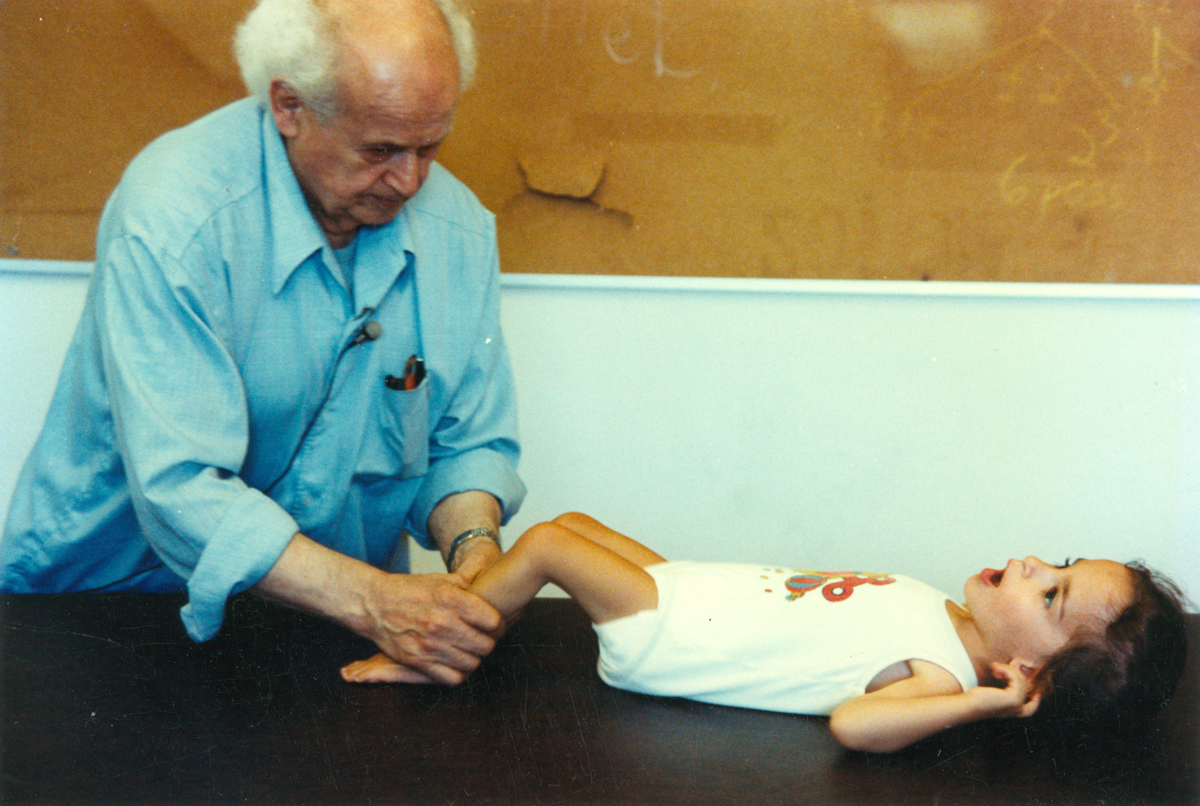
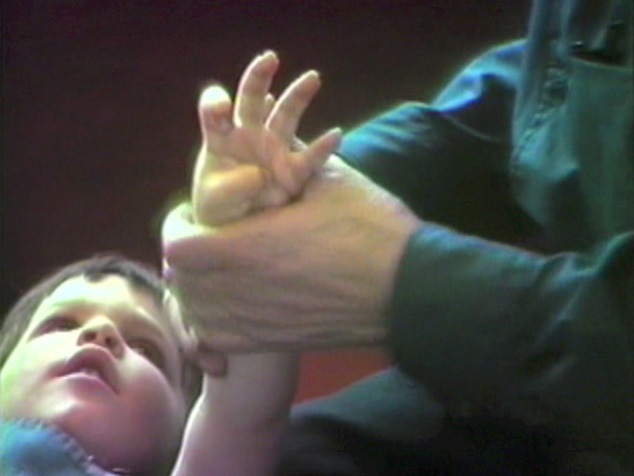
 International Feldenkrais® Federation